
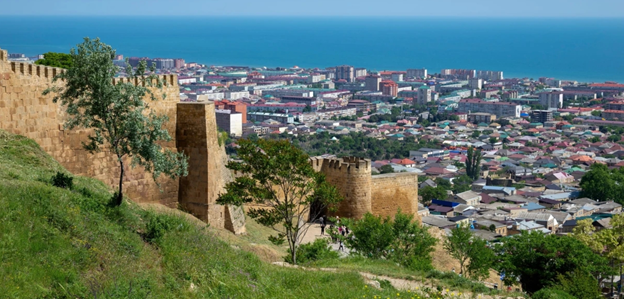
Caucasian States in the context of regional instability
Brief description: This article provides an overview of the current geopolitical situation in Transcaucasia and the South Caucasus over the specified time period. The relations between Georgia and the EU are being considered, where the European Commission qualifies Georgia as only a nominal candidate due to “deviation from democratic principles” with subsequent exclusion from European integration programs. Regional security issues in Transcaucasia are also highlighted, including NATO visits and the implementation of transport projects such as the Zangezur Corridor. The article also reflects the internal political changes in Georgia, including the adoption of new voting rules for citizens abroad.
Preface
There is an intensification of diplomatic contacts and international initiatives in the region, such as discussing regional transport corridors and ensuring peace in Transcaucasia. But at the same time, the situation around Georgia’s foreign and domestic policy testifies to complex and multifaceted processes on the country’s path to the Euro-Atlantic space. After repeated assessments and decisions, the European Union has again questioned Georgia’s status as an EU candidate. At the same time, internal political changes are taking place in Georgia, in particular, the adoption of new voting rules aimed at regulating the participation of citizens abroad. In this dynamic, combining internal reforms, diplomacy, and foreign policy challenges, the Caucasus region faces important questions about its future, status, and future development strategy.
The EU and Georgia: what’s next?
In early November, the European Commission qualified Georgia as a “nominal” candidate country for the EU due to a “retreat from democracy,” according to an EC statement.
“After the decisions of the European Council of December 2024, which concluded that the process of Georgia’s accession to the EU has been de facto suspended, and in light of the ongoing rollback from the principles of Georgia’s democracy, the European Commission considers Georgia a candidate country only nominally,” the document says.
However, the doors of the European Union will remain open for Georgia if the country’s authorities decide to change their course of action and return to European principles and values, said EU Ambassador Pavel Gerchinsky.“As you heard from the press conference, the European Commission does not perceive Georgia as a candidate country, it is a candidate country only on paper. It’s very sad for me. But at the same time, I want to emphasize that the doors of the EU remain open for Georgia again if the leadership changes its course of action and returns to the principles and values on which the European Union is based,” Gerchinsky said at a press conference.

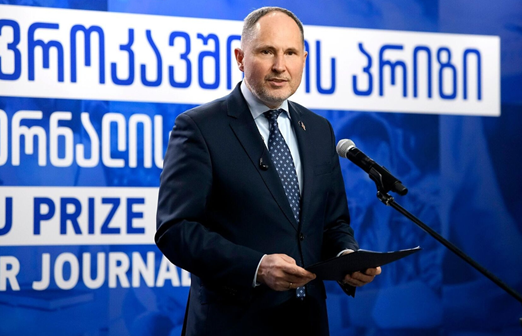
EU Ambassador Pavel Gerchinsky
According to him, Georgia is much further away from EU membership than in 2023, when it was granted candidate status.
After some time, the situation escalated again. The European Commission did not invite Georgia to the EU enlargement forum on November 18 for the same reason of “moving away from democracy,” EC representative Guillaume Mercier said at a briefing in Brussels.“We recently published a report on the progress of the candidate countries, which states that we now consider Georgia only a nominal candidate for the EU. We regret to note Georgia’s further removal from the European democratic path… Yes, we can confirm that Georgia was not invited to our forum for these reasons,” he said in response to a question from reporters.


Flags of the European Union and Georgia
Overall, the situation shows that Georgia’s prospects for integration into the European Union are under threat due to the ongoing retreat from democratic principles. The European Union leaves the door open for a possible return of the country to European values.
NATO, Baku and Yerevan: discussion of the peace process
Hikmet Hajiyev, Assistant to the President of Azerbaijan and Head of Foreign Policy at the Presidential Administration, held a meeting with the NATO delegation, which is on a visit to Baku. The NATO delegation included representatives to the alliance from Turkey, Greece, Hungary, Montenegro, the Netherlands, North Macedonia, Norway, Slovakia, Slovenia, Sweden, the Czech Republic, Portugal, Spain, as well as Deputy Permanent Representatives of the United States and France to the alliance.
“I am pleased to meet with the permanent representatives of the NATO member states who are on a study visit to Azerbaijan. We got a general idea of the fruitful and successful partnership between NATO and Azerbaijan, as well as exchanged views on regional security issues and the promotion of the peace agenda between Azerbaijan and Armenia,” Hajiyev wrote on the social network.

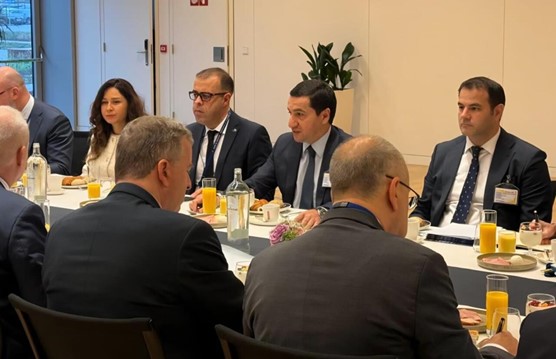
Meeting of Hikmet Hajiyev, Assistant to the President of Azerbaijan and Head of Foreign Policy of the Presidential Administration, with the NATO delegation
This visit demonstrates Azerbaijan’s desire to continue strengthening dialogue and cooperation with NATO, emphasizing the importance of regional security and the search for peaceful solutions to conflict issues such as interstate relations with Armenia. Such a dialogue contributes to the expansion of international support and stability in the region.
“Trump’s route for International Peace and Prosperity”
The construction of the “Trump Route for International Peace and Prosperity” (the Zangezur Corridor) in Azerbaijan is nearing completion, President of the Republic Ilham Aliyev said.“The construction of the Zangezur corridor in Azerbaijan is nearing completion. The railway with a capacity of 15 million tons will initially become an important artery of the Middle Corridor (Trans–Caspian International Transport Route),” he said, speaking at the 7th Consultative Meeting of the Heads of State of Central Asia in Tashkent.


President of the Republic of Azerbaijan Ilham Aliyev
“Joint efforts to modernize the transport and logistics infrastructure, synchronization and digitalization of customs procedures open up wide opportunities for increasing cargo transportation volumes, strengthening economic stability and expanding cooperation in international markets,” the head of state noted.
It is worth recalling that in early August 2025, following the meeting of Azerbaijani President Ilham Aliyev and Armenian Prime Minister Nikol Pashinyan with US President Donald Trump in Washington, a declaration was adopted on the initialing by the Foreign Ministers of Armenia and Azerbaijan of the agreed text of the agreement on the establishment of peace and interstate relations between the two countries. Yerevan also agreed to cooperate with the United States and third parties to create a “Trump Route for international peace and prosperity.”

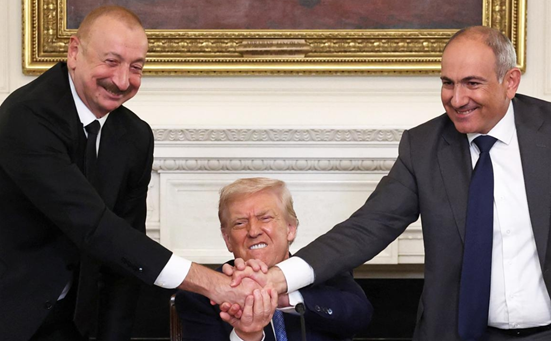
Meeting of Azerbaijani President Ilham Aliyev and Armenian Prime Minister Nikol Pashinyan with US President Donald Trump in Washington
The named route implies unblocking transport links between the main territory of Azerbaijan and its exclave autonomy in Nakhichevan through the territory of Armenia.
New voting rules
The Parliament of Georgia has approved in the first reading a new Electoral Code, according to which citizens of the country who are abroad will be prohibited from voting in the parliamentary elections, the voting was broadcast live on the website of the legislative body.
76 deputies voted in support of the bill, 9 opposed it. According to the document, Georgian citizens will be able to vote in the parliamentary elections if they only come to their homeland. Earlier, the ruling Georgian Dream party stated that there are special risks for non-resident citizens who are influenced by a foreign jurisdiction and a political environment in which the state is unable to prevent interference. Parliament Speaker Shalva Papuashvili said earlier that the establishment of voting rules in Georgia ensures a more adequate and informed choice. According to him, this model fully complies with international standards and operates in countries such as Ireland, Malta, Israel, and Armenia.

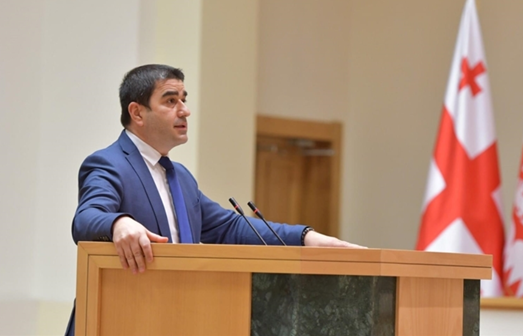
Speaker of the Parliament Shalva Papuashvili
Conclusion
Summing up, it can be noted that the situation in the Caucasus region is ambiguous: while Armenia and Azerbaijan are gradually moving towards a peaceful settlement, the situation in Georgia remains tense and multifaceted. The European Union assesses Georgia’s current status as an EU candidate, pointing to a retreat from democracy and domestic policy priorities, which moves the country away from membership and limits its participation in European integration processes. At the same time, visits by international organizations and States such as NATO and the United States indicate continued attention to the region and its security issues, especially in the context of transport corridors and peace in Transcaucasia. Significant changes are taking place within the region, including reforms of the Georgian electoral legislation aimed at strengthening control and ensuring stability in political life. In general, these events demonstrate a dynamic and complex process of balancing domestic policy and foreign policy interests.
Scenario 1. Georgia’s further estrangement from the EU and the deterioration of the situation between Armenia and Azerbaijan: Internal and external political events provoke a negative reaction from the EU and international organizations. The European Union is tightening its position, officially confirming that the accession process has actually been suspended, and demanding changes from the Georgian authorities. There is an increasing debate within the country about the timing and methods of reforms, but it is becoming increasingly difficult for the leadership to justify current actions to citizens and the international community. Internal instability may increase and confidence in the government may decrease. If the situation does not change, the EU will become more distanced, and Georgia’s integration prospects will worsen. International partners may begin to review relations, increasing pressure on domestic reforms or even limiting support.
After the opening of transport routes, Azerbaijan and Armenia are beginning to face a new round of distrust and possible provocations. Azerbaijan can accuse Armenia of failing to ensure the safe use of new routes, and Armenia of trying to complicate the implementation of agreements, which leads to a decrease in trust.
Scenario 2: Return to the European integration course and further Armenian-Azerbaijani cooperation: The Georgian leadership, realizing the deterioration of relations with the EU and the loss of prospects for rapid membership, initiates large-scale reforms aimed at restoring democracy, the rule of law and the protection of human rights. The government actively participates in international consultations and dialogues with the EU and other European organizations. Georgia is initiating concrete steps to meet EU requirements, including reforms in the judicial system, the fight against corruption and ensuring transparency. As a result, the Candidate’s status is formally returned, and the country once again receives an invitation to new forums on EU enlargement.
Meanwhile, due to the completion of the construction of the Zangezur corridor and the launch of the highway, Azerbaijan, Armenia and international partners are strengthening cooperation on the development of transport infrastructure. The new railway and bridges make it possible to use the trans-Caspian route more actively, which creates additional economic opportunities and promotes the development of regional trade. Within the framework of international initiatives, in particular with the participation of the United States, the EU and NATO, the parties continue to implement agreements to establish peace and stabilize relations. Armenia and Azerbaijan make it clear that the development of transport corridors and the exchange of logistics experience do not contradict their interests and serve the international agenda for strengthening security in the Caucasus.