
Brief description:
The article is devoted to the analysis of the political and informational confrontation around the events in relations between the United States and Venezuela. It examines how military and economic actions are accompanied by a struggle for the interpretation of what is happening in the media space, as well as how issues of sovereignty, control over resources and international legitimacy become the subject of not only diplomatic, but also cultural conflict. Special attention is paid to the role of language, mass media and political rhetoric in shaping public perception of international events.
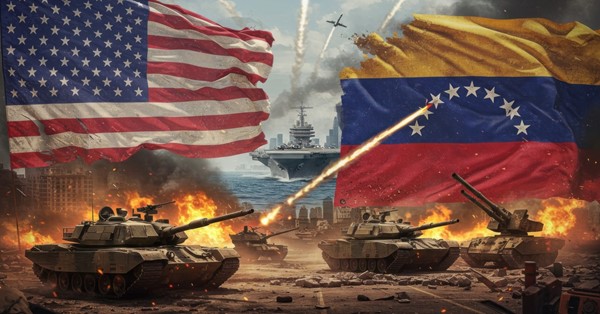
In addition to the noise of the military attack on January 3, which resulted in Venezuela being defeated on the battlefield, another battle began the very next day. And even if no troops were deployed, a more subtle process was launched: a silent occupation seeking to convince Venezuelans that the establishment of a stronger government is natural, inevitable, and even reasonable. The dispute is no longer on the military front, but in the sphere of perception of common sense.
THE CULTURAL BATTLE
If the military offensive lasted only a few hours, then the cultural war can drag on much longer. Its strength is no longer the army, but language and the media. It is there that collective ideas are formed and attempts are made to instill conformity and the idea that sovereignty is an anachronism.
APPROVAL
Antonio Gramsci emphasized almost a century ago that power is supported not only by force, but also by the ability to form consensus. Decades later, Robert W. Cox applied this idea to the field of international relations. The government dominates not only because of its military superiority, but it truly dominates when it manages to make its superiority generally accepted and “common sense.”
SOVEREIGNITY
At the heart of this dispute is a fundamental concept: national sovereignty. This is the principle according to which a country has the supreme power to determine its own destiny without subordination to external forces. This is not an abstract ideal or a romantic aspiration. This is the practical basis on which the modern international system is built.
Cooperation between countries is part of the modern world and it should be different from subordination. Relations are legitimate when they are based on mutual respect, and not on military imposition.
THE OFFENSIVE
The dispute over the significance of the events of January 3 forms the first trench of this cultural war. It’s not bombs that are used in this arena, but language. By choosing words and constructing a narrative, an attempt is being made to conceal the nature of the events.
For this reason, terms such as bombing, assault, invasion, or crime and aggression are disappearing and being replaced by expressions such as “incident,” “extraction,” “event,” and “surgical operation.” Similarly, what is actually external control over domestic policy is presented as a neutral three-step process: “stabilization, recovery, and transition.”
NATURAL RESOURCES
Another aspect of this hidden occupation is the economic sphere. An attempt is being made to present as the norm the fact that a foreign power controls oil and its marketing, manages national revenues and decides how and for what they are used. Cultural hegemony acts when this control begins to be perceived as logical and beneficial.
Washington describes itself as a “partner,” a term that in its true meaning refers to a cooperative relationship between parties with equal rights. However, here it refers to a situation in which one of the parties controls sales, manages revenue, and sets conditions through licenses.
Washington’s management of Venezuela’s revenues is presented as “protection.” The naval blockade of oil is called a “quarantine”. The forced purchase of rican products is called a “trade commitment.”
RECOVERY
Now the cultural war is being waged not only from one side. There are also protection mechanisms:
The first is the restoration of a language that allows you to describe reality without imposed filters and call a spade a spade again.
Clarity is not radicalism, and an open explanation of what is happening is a necessity. The Venezuelan media should present facts without filters; politicians, both in government and in opposition, should reveal their meaning; cinematographers should translate them into images; and the armed forces should publicly honor the memory of fallen soldiers.
OCCUPATION
At the moment, the real threat to the country lies in the entrenchment of the idea of the inevitability or even convenience of subordination. If external guardianship is perceived as a practical solution, and sovereignty as an outdated concept, defeat will be not only military, but also cultural. The military occupation may end. But knowledge that requires common sense can be passed down from generation to generation.