
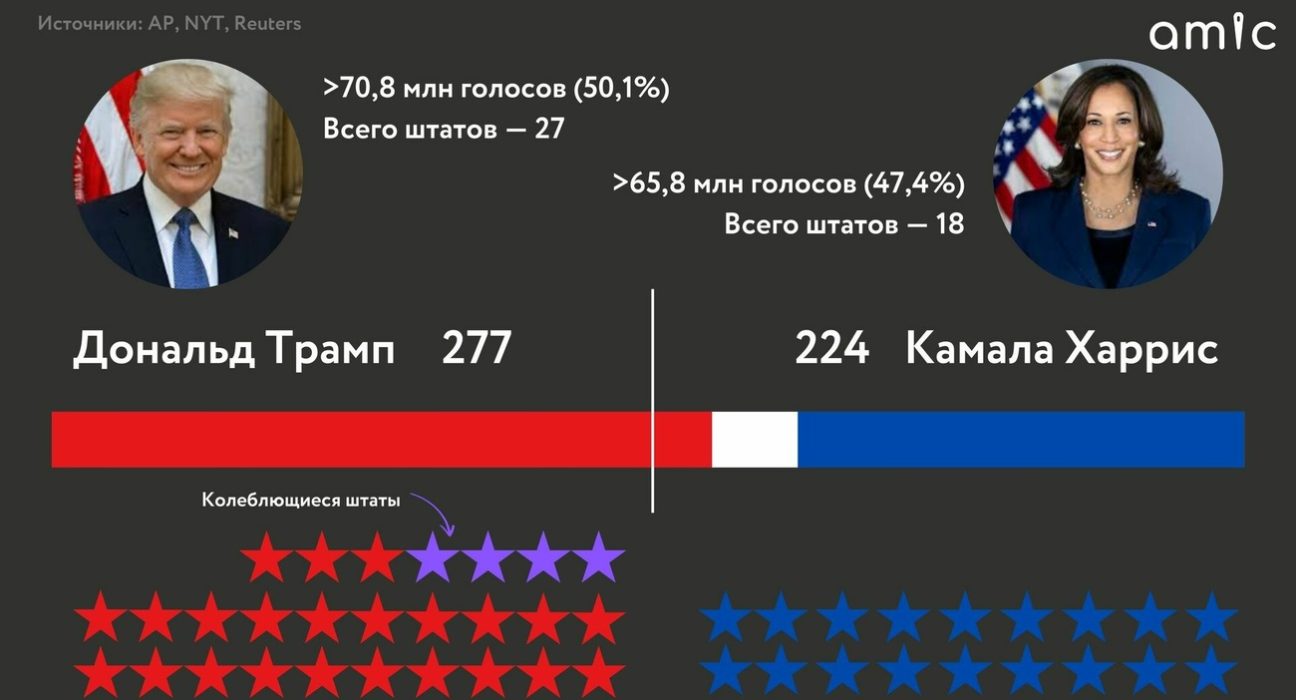
On 5 November 2024, the US held a presidential election that will determine the further vector of the country’s domestic and foreign policy course for the next 4 years. Representatives of two traditionally opposing parties – former President Donald Trump from the Republican Party and Vice-President Kamala Harris from the Democratic Party – took part in the election. As a result of the voting, D. Trump won a confident victory with 73 million electoral votes and 295 electoral votes compared to 68 million electoral votes and 216 electoral votes for K. Harris.
Donald Trump, during a speech to his supporters, declared that he had achieved a “tremendous victory” in the election for the benefit of all American people. He promised to usher in a “golden age” for America. Trump also expressed confidence that Republicans had gained control of both chambers of the U.S. Congress.
Trump is a bold and distinctive figure in both politics and business. Throughout the campaign, he made numerous significant statements about his vision for the future of the country and the world. Although his rhetoric may shift in the future, he has clearly laid out his intentions for reshaping the world.
Impact on the U.S. Economy
The new president’s first priority will be to tackle inflation and the growing national debt. As an experienced businessman, Trump plans to cut various government expenditures and introduce substantial new tariffs on foreign goods. He has consistently advocated for protectionist policies and the development of domestic industries.
Changes in the U.S. Political System
Trump has long aligned himself with Republican ideals and has shown a strong opposition to liberal policies. As president, it’s likely he will cut spending on several social programs and strengthen the executive branch’s role, giving himself more authority in key decision-making areas. In foreign policy, Trump views China as the primary competitor to the U.S. and plans to direct significant efforts toward countering it. His goal is to reinforce America’s strategic position in the Asia-Pacific region.
Immigration Policy
Trump’s critical stance on immigration has been well known for years. He believes that low-cost labor from neighboring countries negatively impacts the economy and harms American workers. Under his administration, it’s anticipated that U.S. immigration policies will become much stricter.
The Conflict in Ukrainе
Donald Trump has repeatedly claimed that, if elected, he would be able to end the conflict in Ukraine within a single day. The Republican has also frequently criticized the White House for lacking direct engagement with Russia.
Trump has stated that he is acquainted with both Vladimir Zelensky and Vladimir Putin, which, he asserts, would allow him to mediate the situation without issue. Moreover, he has claimed that, under his leadership, military action might never have occurred. Trump has often emphasized his willingness to engage in dialogue with Russia, noting that the most dangerous aspect of the Ukraine conflict is the breakdown of diplomatic negotiations. Now, with a more straightforward, open president at the helm, Trump believes the U.S. could potentially bypass bureaucracy and other obstacles to pursue solutions.
However, Trump’s stance on Ukraine is pragmatic and cautious. He has pointed to Ukraine as a country plagued by corruption, struggling to sustain its government structure and damaged economy despite billions of dollars in aid from Europe and the U.S., while facing severe depopulation. Unlike Democrats, Trump is reluctant to invest large sums in Ukraine without seeing any tangible success on the battlefield. Still, Trump has indicated a willingness to seek compromise in the conflict. His ability to follow through, however, may be influenced by the so-called “deep state” in the U.S., which was particularly apparent during his first term when, despite his intentions, anti-Russia sanctions were not only maintained but strengthened.
In this context, one possible outcome might involve Ukraine acknowledging a need for compromise and agreeing to peace terms with Russia in order to avoid a collapse of Ukrainian statehood.
Relations with the EU and NATO
Trump’s first term posed a significant challenge to transatlantic partnerships. He repeatedly criticized European nations for insufficient defense spending, referencing the 2% GDP benchmark agreed upon at the 2014 NATO summit in Wales. This has left Europe apprehensive about the prospect of Trump returning to the White House. In response, the European Commission and several EU countries have discussed forming a task force to develop strategies for addressing potential Republican policies, as well as initiatives to partially offset a possible reduction in U.S. military support.
A second Trump administration could also strain economic cooperation across the Atlantic. In late October, Trump announced plans to impose a 20% tariff on European goods and a 60% tariff on Chinese imports if he wins the presidency. The future of Washington-Brussels relations under Trump would likely depend on many factors. Most predict that his administration might quietly continue Biden’s approach, aiming to weaken the European economy — a move some view as aligned with U.S. strategic interests.
What to Expect in the End
Once again, the Republican slogan “Make America Great Again” has taken center stage, with Trump’s campaign promises heavily focused on domestic policy. This suggests that his attention to foreign influence may be somewhat reduced. Trump could scale back on certain global initiatives that divert resources, instead reinforcing a clear principle: if you want to work with the U.S., you should invest in the American economy, create jobs, register innovations, secure patents, and list your companies on U.S. stock exchanges. Trump’s primary goal appears to be tackling domestic issues, including resource management, illegal immigration, and social support for American citizens. In foreign policy, his interests are likely to concentrate on countering China, supporting Israel, and strengthening U.S. influence in the Middle East. At the same time, Trump may be open to improving relations with BRICS, or at least pursuing a more constructive dialogue.