
Evolution of the regional security architecture in the context of growing multipolarity
Short description: The article examines the key geopolitical events in Southeast Asia in October-November 2025. The period under study was marked by a further escalation of maritime incidents in the South China Sea between China and the Philippines, the creation of a joint US-Philippine operational headquarters, and the record presence of Chinese forces in disputed areas. At the same time, the 47th ASEAN Summit in Kuala Lumpur led to the historic expansion of the bloc through Timor-Leste’s full membership and successful mediation in the Thai-Cambodian border dispute. Myanmar continued to experience a deepening humanitarian crisis and territorial fragmentation, while Vietnam and Indonesia actively promoted economic diplomacy with the United States and alternative partners. These processes reflect the region’s transition to a more complex and multipolar system of interactions, where ASEAN retains a coordinating role, but is faced with the growing influence of external factors and the need for parallel development of both collective and bilateral mechanisms for managing security risks and economic challenges.
Preface
During the period October-November 2025, Southeast Asia experienced a series of events highlighting tensions over maritime and border issues, as well as efforts to strengthen regional institutions. The escalation in the South China Sea remains the dominant factor, where incidents between Chinese and Filipino vessels have intensified diplomatic exchanges and stimulated the creation of new coordination mechanisms involving external partners. At the same time, the 47th ASEAN Summit in Kuala Lumpur (October 26-28) was marked by the expansion of the bloc through Timor-Leste and mediation in the Thai-Cambodian dispute, which demonstrates the organization’s potential in conflict management. In Myanmar, the humanitarian situation has been exacerbated by new movements due to the fighting, while Vietnam and Indonesia have promoted economic initiatives to diversify ties. These processes illustrate the balance between security challenges and institutional development opportunities, contributing to the formation of a more stable geopolitical configuration in the macroregion.
Escalation in the South China Sea and new coordination mechanisms
In October-November 2025, the South China Sea once again became the epicenter of tension between China and the Philippines. The most serious incident occurred on October 10 at Scarborough Reef (Huangyan), when two vessels of the Coast Guard of the People’s Republic of China used water cannons against the Philippine supply boat Unaizah May 4, en route to the shoal of Sekenda Thomas (Ayungin) for the rotation of marines on the stranded amphibious assault ship BRP Sierra Madre. As a result of the maneuvers, one of the Philippine vessels suffered hull damage, and two servicemen received minor injuries. The Philippine side described China’s actions as “dangerous and provocative,” while Beijing said it “legitimately prevented the illegal invasion of Chinese waters.”
On November 11, a second incident occurred off the same Scarborough Reef: Chinese vessels blocked and fired water cannons at the Philippine fuel and food delivery mission. In response, on November 14, the United States and the Philippines announced the establishment of a permanent joint operational headquarters (Joint Maritime Activity Coordination Hub) under the auspices of the 1951 bilateral Mutual Defense Treaty. The headquarters, located in Manila, is designed to coordinate the actions of the Navy and Coast Guard of the two countries in real time, including joint patrols and intelligence sharing. On November 20, the first exercises were held in the area with the participation of the American destroyer USS Higgins and the Philippine frigate BRP Jose Rizal.
China reacted harshly: Foreign Ministry spokesman Lin Jian called the creation of the headquarters an “attempt to “involve external forces in regional disputes” and warned of possible “countermeasures.” At the same time, Beijing has stepped up patrols: in November, up to 42 ships of the People’s Liberation Army and the navy were recorded operating in the Spratly region simultaneously (a record since 2022).
Analysts note that the escalation is taking place against the background of a change of administration in the United States: the team of Donald Trump, who took office in January 2026 (following the results of the November 2024 elections), demonstrates its readiness to more actively contain China in the Indo-Pacific region. At the same time, the Philippines, under the leadership of President Ferdinand Marcos Jr., continues its policy of “transparent coverage of incidents” by publishing videos of clashes, which strengthens international support for Manila from Japan, Australia and EU countries. Thus, the South China Sea is turning into a zone of institutionalized rivalry, where one-time reactions are replaced by permanent coordination structures, which increases the risks of uncontrolled escalation, but at the same time creates predictable channels of interaction.
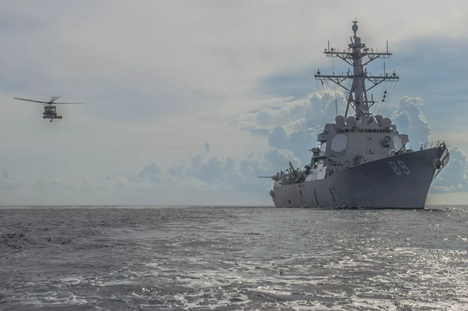
US Navy Destroyer Mustin in the South China Sea
47th ASEAN Summit: Expansion of the bloc and mediation in border disputes
The 47th ASEAN Summit and related meetings with ASEAN+3 partners, the East Asia Summit and the ASEAN Regional Forum were held in Kuala Lumpur from October 26 to 28, 2025. The summit was the first under Malaysia’s chairmanship since she took office in January 2025 and was marked by two historic decisions.
First, on October 27, the leaders of the ten member countries unanimously accepted Timor-Leste as the 11th full member of ASEAN from January 1, 2026. Dili received observer status back in 2011, and candidate status in 2022. The decision was accompanied by the signing of an Integration Roadmap: Timor-Leste commits to ratify more than 40 key agreements of the bloc by the end of 2027 and will receive a three-year transition period for participation in the ASEAN Economic Community (AEC). Timor’s Prime Minister Xanana Gusmau called it “a homecoming to the Southeast Asian family,” while Malaysian Prime Minister Anwar Ibrahim stressed that the expansion “strengthens ASEAN’s centrality and makes the bloc more representative.”
Secondly, on October 28, the Kuala Lumpur Ceasefire and Demilitarization Pact was signed under the auspices of ASEAN in the disputed area on the Thai-Cambodian border near the Phra Vihear Temple (Khao Phra Vihan). The conflict, which has been escalating periodically since 2008, again led to shootouts in October 2025 (two Thai and one Cambodian soldiers were killed). The Pact provides for:
— withdrawal of heavy weapons 5 km from the demarcation line;
— Creation of a 3 km wide demilitarized zone under the supervision of the Malaysian-Indonesian monitoring mission (200 people);
— the resumption of the work of the Joint Border Commission until March 2026.
The signing was ASEAN’s first successful mediation operation in a land-based territorial dispute in the last 15 years and strengthened Malaysia’s position as an “honest broker.”
The Kuala Lumpur Declaration on Digital Transformation (2026-2030) was also adopted on the sidelines of the summit.;
— Framework agreement on the establishment of the ASEAN Power Grid (the first stage is the Laos–Thailand–Malaysia–Singapore energy ring);
— a statement on the inadmissibility of the use of force in the South China Sea calling for speeding up negotiations on the Code of Conduct (CoC), the text of which, according to the Malaysian Foreign Minister, is already 90% ready.
Along with the summit, bilateral meetings were held: China–ASEAN (Li Qiang confirmed his readiness to complete the CoC by the end of 2026), the United States–ASEAN (Secretary of State Marco Rubio announced the allocation of an additional $150 million for the maritime security of the member countries), Japan–ASEAN (a new package of investments in “green” infrastructure for $25 billion). Thus, despite external challenges, ASEAN has demonstrated its capacity for institutional growth and practical conflict management steps, which strengthens its central role in the regional security architecture.
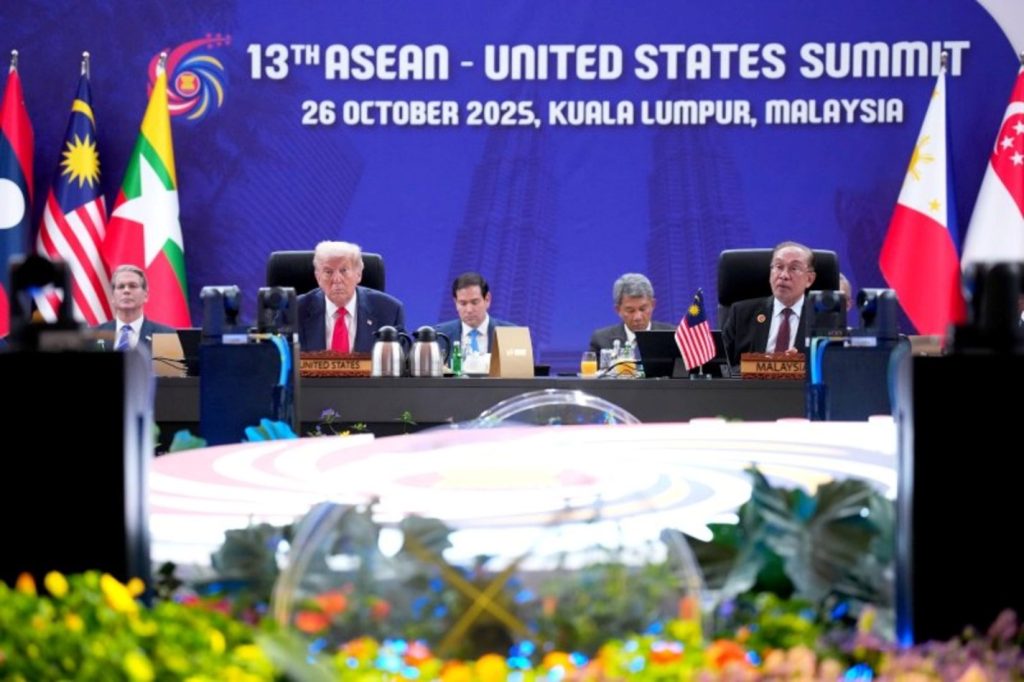
47th ASEAN Summit
The humanitarian crisis in Myanmar and its regional consequences
In October-November 2025, the armed conflict in Myanmar reached a new peak in intensity, turning the country into the largest source of internally displaced persons in Southeast Asia. According to UNHCR data on November 25, the total number of internally displaced persons exceeded 3.4 million, and about 1.2 million more fled to neighboring countries (720 thousand of them to Thailand, 310 thousand to India and 120 thousand to Bangladesh).
Key events of the period:
On October 18-29, the offensive of the Three-Brother Alliance coalition (MNDAA, TNLA and AA) in northern Shan led to the capture of the city of Lasho and the encirclement of the state capital. On November 4, the Arakan Army (AA) fully established full control over the entire territory of Rakhine State, including the port of Kyaukpyu, a strategic outlet to the Bay of Bengal. On November 12, the State Administrative Council (SAC, the military junta) announced a unilateral cease-fire until the end of the year, but fighting continued in Kachin and Karen.
The humanitarian collapse in Rakhine was particularly alarming: after the AA captured the capital of Sittwe State on November 11, about 180,000 Rohingya and Buddhist Rakhines found themselves in an active fighting zone. On November 22, the UN announced the complete cessation of food supplies to Rohingya camps due to the road blockade. At the same time, a sharp increase in maritime migration was recorded: according to the IOM, in October-November, more than 4.2 thousand people tried to leave Myanmar by boat towards Malaysia and Indonesia (an increase of 68% compared to the previous year).
The reaction of the ASEAN countries remains extremely cautious. Thailand opened nine “temporary shelters” along the border on November 15, but refuses to identify those arriving as refugees, emphasizing the “humanitarian nature” of the reception. Indonesia and Malaysia have stepped up maritime patrols: on November 19, the Indonesian Navy intercepted three ships carrying 780 Myanmar men off the coast of Aceh and transferred them to a camp on Sebilang Island. At the ASEAN summit in Kuala Lumpur, the leaders limited themselves to a general statement on “the need for humanitarian aid to be delivered by all parties to the conflict,” without mentioning the junta or the opposition by name.
External actors have also become more active: on November 8, China evacuated 4.8 thousand of its citizens from Lashaw, while strengthening its military presence on the border with Yunnan Province. On November 21, India announced the allocation of $15 million for humanitarian corridors, but continues to supply weapons to SAC under previously concluded contracts.
Thus, the crisis in Myanmar is turning into a long-term destabilizing factor for the entire subregion, increasing the burden on migration systems, drug trafficking (methamphetamine production in Shan increased by 33% in a year) and cross-border crime, with limited ASEAN’s ability to directly intervene.

Food aid in Pyinman
Conclusion and development scenarios
In October-November 2025, Southeast Asia confirmed its status as one of the most dynamic macroregions on the planet, where the interests of great powers intersect and internal institutional maturation takes place at the same time.
Key results of the period:
— The South China Sea has transformed from a zone of episodic incidents into a space of permanent operational presence and coordination (the joint headquarters of the United States and the Philippines, a record number of Chinese vessels);
— For the first time in many years, ASEAN has shown real mediation effectiveness (Timor-Leste, the Thailand-Cambodia pact), but remains extremely cautious in the main crisis in the region — Myanmar.
The emerging picture points to the final transition from “ASEAN centrality” as a declarative principle to a real multipolar architecture in which the bloc acts not as an arbitrator, but as a coordination hub between competing coalitions.
Forecast scenarios for the coming months:
Scenario 1. “Managed multipolarity” The Code of Conduct in the South China Sea is signed in a simplified version by the end of 2026. The US–Philippines Joint Headquarters is expanding to the “4+1” format (USA, Philippines, Japan, Australia + Vietnam has observer status). ASEAN is launching its own maritime monitoring mission (10-12 vessels under the flag of the block). Myanmar remains a “frozen conflict” with humanitarian corridors under the control of China and Thailand. Economic integration is deepening through RCEP+ and new “China+1” supply chains.
Scenario 2. “Severe bifurcation” After another serious incident (collision with losses) in the South China Sea in 2026, the Philippines activates Article 4 of the Mutual Defense Treaty. The United States is introducing a permanent presence of an aircraft carrier group in the Spratly region. China is responding with economic sanctions against Manila and Malaysia. Myanmar is fragmenting into three control zones (SAC, “Three-Brother Alliance”, AA), provoking a new flow of refugees.
Scenario 3. “Regional pragmatism” Under the pressure of economic losses (decline in tourism, logistics) China and the United States agree on a temporary “maritime truce” based on the INCSEA model of 1972. ASEAN gets the role of the guarantor. At the same time, the China–USA–ASEAN trilateral dialogue on critical minerals and energy grids is being launched. Myanmar is moving towards a federal model under international pressure.
The first scenario remains the most likely: the region will continue to balance, avoiding direct confrontation, but gradually institutionalizing new lines of division and coalitions.