
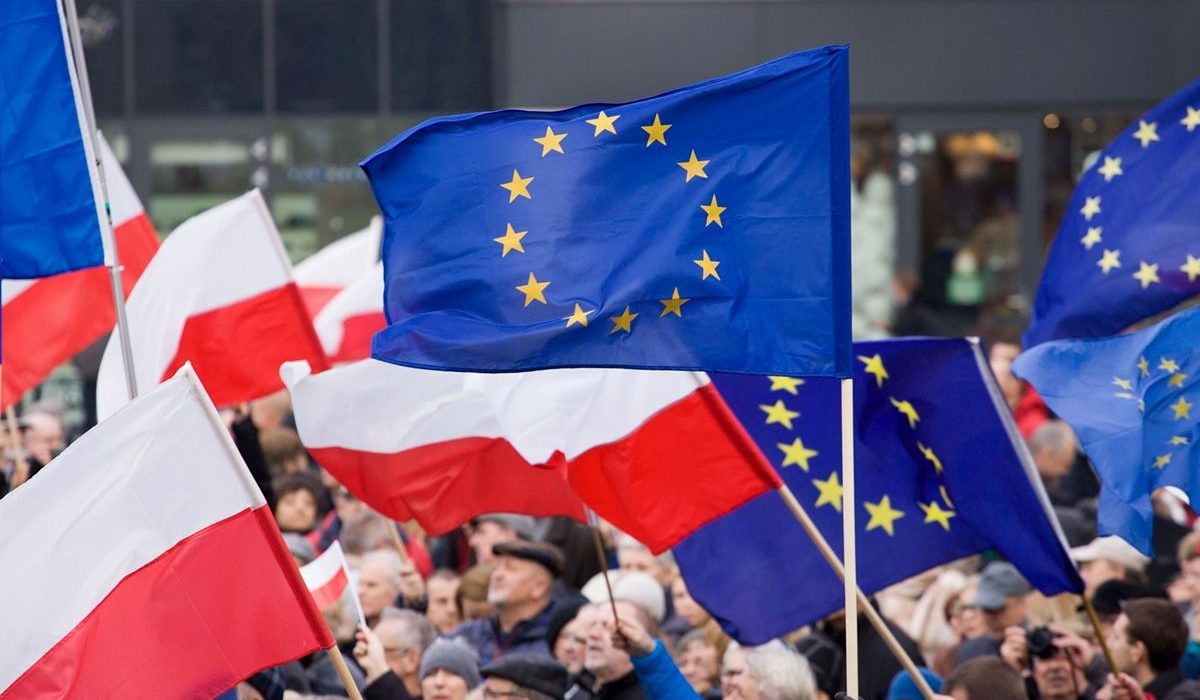
Poland has always been a country with a rich yet turbulent history, from being a strong and powerful state during the Polish-Lithuanian Commonwealth era, to suffering the Third Partition carried out by Russians, Austrians, and Prussians, and later becoming the Tsardom of Poland after the Congress of Vienna. Subsequently, it experienced regency, the Second Polish Republic, Nazi and Soviet occupation, incorporation into the USSR, and eventually independence in 1989, followed by NATO entry in 1999 and EU accession in 2004.
Poland, however, has always oscillated westward. On maps, present-day Belarus corresponds to the eastern regions of Poland, while the western zones of Poland were on the border or even within German territories of the past empires. The truth is that Poland has been situated between two expansive, industrial powers with strong economies and strict discipline: Russia and Germany.
This has generated an interest in enhancing its cultural position (Catholics versus Protestants in the west and Orthodox in the east), strengthening institutions, and seeking neighboring alliances, especially with Lithuania, through which it manages relations with the Baltic countries and reinforces its northern flank and coastline.
At the same time, Poland has always aspired to be the leader of the western Slavic region, positioned between the Germanic bloc to the west and the Russian to the east, which, given its size, political density, population, and economic capacity, aligns with this role. The Warsaw government has developed these ideas from ancient times. In fact, the current international actions in the Central and Eastern European region, against Russia and Western powers, are deeply rooted in understanding Poland’s historical aspirations, affiliations, and fears.
The two major theorists who shaped, expanded, and refined these ideas depending on circumstances were Czartoryski and Piłsudski.
Czartoryski, who fought against the Russians and later served the Tsars, identified Russia as a predatory empire seeking to dominate the nations it conquered. He believed that Russia would leverage its considerable economic and demographic power, its diplomatic agility, and its imperial ambitions to threaten Europe.
Besides providing diplomatic arguments against Russia’s threat (already recognized at the Vienna Congress after the Napoleonic Wars), Czartoryski fought for Poland’s independence and the incorporation of Prussia (future German Empire), which he saw as another danger due to its industrial power, discipline, and duty rooted in Frederick the Great’s legacy. The West—the Germans—also posed a threat.
An interesting principle introduced by Czartoryski in his essay On Diplomacy (1830) was that support should be given to the Russian peoples in their quest for independence. This idea was further developed by Piłsudski in the 1920s, during his political career from 1918 onward, and has been echoed in speeches by Donald Tusk (current Polish Prime Minister) and, historically, by Lech Wałęsa. Tusk declared support for ethnic minorities in Russia, describing them as under imperialist rule, advocating for their independence. This connects to the Promethean idea developed by Piłsudski, but that already appears in Czartoryski’s work, with support for Caucasian groups, especially Georgia. We are talking about the earliest sketches of these ideas in the 19th century.
Czartoryski argued for an independent Poland controlling Prussia and serving as a bulwark against Russia, protecting Europe and supporting local Russian groups against the empire. Piłsudski took this theory further.
Międzymorze, the grand theory
Promotes a Polish-Lithuanian axis covering the Baltic, Belarus, and Ukraine. However, the federation clashed with opposition from neighboring states that had regained independence and wished to join the Westphalian community of nations. They feared Polish dominance and did not want to be part of a community where Polish interests would overshadow theirs.
From Moscow, opposition was intensified, sabotaging Piłsudski‘s plans. Western powers also viewed Intermarium as an impossible utopian project, preferring not to damage their alliance with Russia, which they thought would be temporary, and they did not want to deal with the consequences later. Additionally, they accused Warsaw of not helping the White Russians during the Russian Civil War. On the other hand, Germany, which had helped overthrow Russian power via Lenin and the subsequent revolution, would not tolerate another threatening power in the east. Germany’s geography highlighted its vulnerable position between France and England to the west and Russia to the east; after removing Russia, it would not accept another threat.
Internally, Piłsudski faced opposition from Poles who favored a homogeneous, unitary Polish republic, a theory defended by Roman Dmowski. The conflicts—Polish-Russian, Polish-Lithuanian, Polish-Ukrainian wars, and border clashes with Czechoslovakia—along with Ukraine’s integration into the USSR, destroyed the initial Intermarium attempt. Poland believed its independence depended on Ukraine’s independence, with the main goal of removing Ukraine from Russian control.
This idea persisted and has resurfaced in the current conflict between Moscow and the West over Ukraine. A more aggressive Poland is particularly interested in Kyiv and in bolstering its military strength.
The second attempt replaced Ukraine with Romania, Hungary, Czechoslovakia, and Yugoslavia to reach the Black Sea and the Adriatic, and to the north with Lithuania and Finland. Yet, this effort also failed. Poland tried to acquire territories from Germany, which ultimately achieved this but not in the 1920s or 1930s. At the Yalta Conference, Poland’s borders were discussed, and Stalin promised to hand over parts of eastern Germany to an independent Poland and hold elections. Stalin’s promises led the Allies to cease supporting the Polish government-in-exile and back Stalin’s project, which ultimately shaped Poland’s current borders with the clear goal of pushing the Polish threat as far west as possible and fighting for a Belarus as a shield—an «airbag»—against any existential threat.
After Piłsudski’s death, Józef Beck proposed a new twist on Intermarium, based on the idea of a third Europe (with a Polish axis) comprising Hungary and Romania as a counterbalance to Western power (exhausted postwar nations, particularly Germany and Russia). The plan never materialized due to political opposition from the Soviet Union and economic dependence on Germany, both Weimar and Nazi regimes. This dependency shifted real power away from local authorities, even Warsaw, into Moscow and Berlin’s hands.
Beyond Intermarium, there’s prometheism. Polish geopolitics has been characterized by fear and rejection of Russia, a country with immense social, military, political mobilization capacity, skilled diplomacy, advanced defense, and sometimes a superior economy—factors that have led to Poland and neighboring nations being swallowed by Moscow.
Prometheism sought to support and guide all Russian regions aspiring for independence, especially those in the Baltic, Black Sea, and Caucasus regions. The aim was to create as many independent states as possible, weakening Russia in the process. These states would serve as a defense front against any Russian threat, respecting each other’s sovereignty, with disputes set aside until the ultimate goal—weakening Russia—was achieved.
It is important to note that this theory, which was attempted with little success, was a consequence of the inability to establish Intermarium. Its action is secondary, with the primary goal remaining: to weaken Russia, shifting from promoting a strong Polish geopolitical space to supporting separatism within Russia itself.
Intermarium, however, remained an idea based on the creation and establishment of a Europe with its own characteristics, centered primarily on Polish politics, diplomacy, economy, and military power, but also being mixed: Slavic, Hungarian, Latin (in the case of Romania), and characterized by the defense of the sovereignty of these countries against the West and Russia.
Today, this is reflected in the construction of regional organizations such as the Visegrad Alliance or the Three Seas Initiative, which are sovereigntist, liberal, anti-communist, and anti-Russian but also somewhat conservative and Eurosceptic. In fact, it is the most ideologically conflicting and protestant region within the European Union. They oppose the Brussels government, viewing Russia as a declared enemy to the point of conflict with other neighboring partners like Hungary or Slovakia. At the latest conference, they accused Russia of imperialism and of being a danger to the Russian peoples, defending their separation (prometheism) while simultaneously having boosted regional Polish institutions and putting into practice the Międzymorze within a context of regional institutionalism, integration, and liberal democratic system. Polish geopolitics thus maintains a worldview of exceptionality concerning the West, fighting against sociopolitical assimilation and against Russia, which is perceived as a real threat to their very existence. This explains their efforts to sever and break all ties with Ukraine so that it falls into the Western sphere and, therefore, Polish influence. Such actions would help Warsaw consolidate its position as a regional leader, provoke Russia’s regression as much as possible, and support separatist and pro-Western movements within Russia, similar to how the West supported Chechens in the 1990s.