In the modern world, there are practically no “blank spots” left. Since the era of the great geographical discoveries, humanity has relentlessly moved toward the conquest of the entire planet. There are no land areas where the human foot has not set, no seas where humans have not ventured, and with the development of aviation and space industries, even the sky is no longer a limit for human possibilities.
In this context, the Arctic currently represents one of the most promising regions on the planet. Fifteen percent of the Earth’s total area is not within the widely recognized or clearly defined borders of any state or group of states. For a long time, these territories and waters, due to their harsh climate and extremely inhospitable living conditions, remained of little interest for exploration and subsequent human settlement. It was only at the beginning of the 20th century that humanity seriously began to “fill in” this last of the “white spots” on the globe.
The development of technology, as well as the rising needs of modern society, has compelled and continues to compel us to pay increasing attention to these territories. The reasons are diverse and can be grouped into several points:
Scientific Interests. As mentioned above, the Arctic remained relatively uninhabited for a long time, which means we do not have sufficient scientifically grounded data on local characteristics, ranging from the behavior of local fauna to the geographical features of continental shelves. This represents a significant challenge for contemporary international security in the region.
Mineral Resources. Beneath the Arctic, locked under endless ice, lies a true storehouse of mineral resources, which in today’s world — due both to the depletion of older sources on one hand and the ever-increasing needs of human society on the other — may become a vital factor for maintaining the current standard of living and consumption.
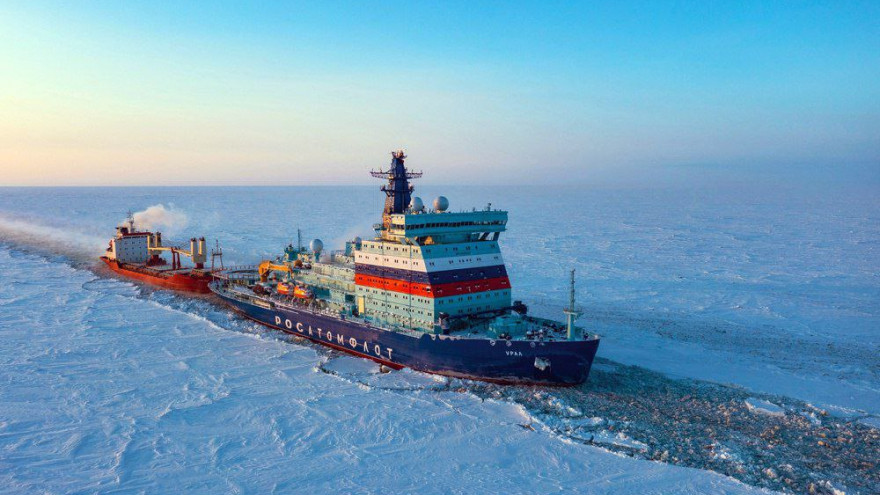
Communications. The process of global warming does not spare even the North Pole of our planet. Passages, straits, and border seas that were previously firmly locked by Arctic ice are, at the current stage — and not without the negative impact of human activity on nature — becoming increasingly navigable. If fully utilized, this will create fundamentally new approaches to global logistics, significantly reducing transit times for goods, shielding them from politically unstable regions, and thereby enabling the global economy to save trillions of dollars.
All the reasons outlined have a macroeconomic and long-term character, which will significantly shape both international politics and global security in the future. This has given rise to the phrase: “Who controls the Arctic, controls the world.” It is therefore especially important to understand how, in the context of an emerging multipolar world with many interested parties, the process of “dividing” this Arctic pie will unfold and how the participants in this process will be able to establish bilateral and multilateral relations with one another.
To continue the discussion on this topic, it is necessary to examine in more detail the interests, goals, and objectives pursued by the participants in international relations. To do this, it is advisable to consider the policies of the main Arctic players:
Russia. The Russian Federation is perhaps the most promising beneficiary of potential Arctic development, which is not surprising given that the country possesses vast Arctic territories both on land and at sea, with its Arctic sector covering nearly half of the entire Arctic region. Moreover, as an energy- and resource-based economy, Russia actively explores oil and gas fields, aiming for the maximum development of Arctic resources and the advancement of projects for their transportation via the Northern Sea Route (NSR). Due to the scale of this activity, the country often faces criticism on environmental issues. In addition, Russia recognizes the Arctic as a special zone of its strategic interests, actively increasing its military presence in the region.
United States. For the United States, which does not possess Arctic territories as extensive as those of other Arctic powers, the main objective is to maximize the internationalization of the Arctic waters and to establish them as a “common heritage of mankind.” This means securing the principles of freedom of navigation and equal access to local resources in the region. To achieve this, the U.S. conducts numerous military maneuvers and exercises, signaling its intent both to protect its own interests and to defend its NATO allies, of which it is the leader. Regarding the development of resources within its sphere of influence, the country also seeks more active exploitation of local deposits, although it often faces environmental restrictions, which are gaining increasing influence domestically.
Canada, Denmark, Norway. These NATO ally countries are heavily dependent on the United States for their own security, yet they retain a significant number of differences that, while not likely to lead to serious military confrontation, prevent a full alignment of their interests with those of the U.S. On environmental issues, Canada takes one of the most radical positions, seeking to limit humanity’s negative impact on the environment, while Norway and Denmark adopt a more balanced approach. To ensure regional security and protect their positions, these countries are more inclined toward dialogue and diplomatic problem-solving, despite NATO support. On multiple occasions, together with Russia, these countries have submitted claims to extend their exclusive economic zones beyond the standard 200 miles; however, due to the impossibility of fully satisfying the demands of all interested states and the roughly equal scientific justification of each claim, decisions on these matters remain unresolved.
Sweden, Finland, and Iceland. These NATO members do not have direct access to the Arctic but are part of the Arctic zone and are members of the Arctic Council. Due to the weakness of their geopolitical position, they limit themselves to economic and scientific projects, without claiming significant portions of Arctic waters, which are effectively already divided among the five circumpolar countries: Russia, the United States, Norway, Denmark, and Canada.
Asia-Pacific Countries. Although geographically distant from the Arctic region, certain countries such as China and India are strong enough to project their interests onto the process of international Arctic governance. In particular, China actively cooperates with Russia within the framework of the “Northern Silk Road” project, which is intended to become a new logistical route for delivering Chinese goods to Europe, reducing China’s dependence on the Strait of Malacca. India is also developing ties with Russia in this area, focusing on the continental route for transporting Arctic resources from Russia’s northern ports directly to India. Currently, international Arctic dialogue is evolving through various formats and platforms that take into account the interests of countries located in the Arctic region, as well as global environmental and economic issues. Some of the main formats include:
Arctic Council (AC): Composed of eight Arctic states (Denmark, Iceland, Canada, Norway, the USA, Russia, Sweden, and Finland). Its primary focus is on sustainable development, environmental protection, and scientific cooperation.
Arctic Economic Council: This format addresses economic aspects related to the development of natural resources, transportation, and trade in the Arctic.
Northern Council: Includes the countries of Northern Europe and addresses issues of cooperation in ecology, economy, and security.
Arctic Group: A non-governmental platform that discusses climate change issues and their impact on the development of Arctic territories. Bilateral and Multilateral Agreements: Numerous alliances and agreements allow countries to coordinate their efforts on specific issues, such as environmental protection and security matters.
It should also be noted that the process of Arctic development faces a large number of problems and challenges that the international community has yet to resolve. In particular, these include competition for resources (oil, gas, minerals), a high potential for conflicts over control of transport routes between Arctic states, the threat of climate change, melting ice and the disappearance of familiar ecosystems, unresolved continental shelf boundaries, and disputed territories. These factors create additional difficulties in Arctic dialogue, increasing military presence in the region and thereby raising the overall level of global concern.
These challenges, in the context of a multipolar world, require a comprehensive approach and active cooperation among all interested parties to ensure the sustainable development and protection of the Arctic.