Since gaining independence, Kyrgyzstan has been objectively interested in the rapid political and economic integration into the global community with all its institutions and processes, with Western countries — primarily the United States — considered by the leadership of the young state as key partners and priority guides.
It should be acknowledged that the United States has made a significant contribution to the formation of modern Kyrgyzstan as a sovereign state and to its society. The history of Kyrgyzstan–U.S. relations spans nearly a quarter of a century, during which Kyrgyzstan has received substantial support from the United States in financial, humanitarian, military, and political matters.
In the area of U.S.–Kyrgyzstan engagement aimed at creating favorable foundations for the development of democratic institutions, USAID has implemented the following programs: “Ak Jol: Path to Peace Through Prosperity” (05/2012–05/2015); Engagement of Young Reporters and Community Leaders in Early Warning and Conflict Prevention (05/2012–05/2014); Strengthening the Judicial System in Kyrgyzstan (09/2011–09/2016); Election Support (06/2004–03/2012); and others. According to USAID press releases, from January 1 to November 11, 2015, the Agency directly or indirectly carried out 44 activities in Kyrgyzstan.
However, in 2015 Kyrgyzstan unilaterally denounced the agreement with the United States on cooperation to facilitate assistance. The intergovernmental document had been signed on May 19, 1993, in Washington. The Kyrgyz government was prompted to take this step following the U.S. State Department’s awarding of the “Human Rights Defender” title to the late Azimzhan Askarov.
Furthermore, all U.S. assistance was provided against the backdrop of Kyrgyzstan’s accession to the Customs Union (CU) and the Eurasian Economic Union (EAEU).
As noted in her 2019 research, A. Temirbekova highlighted that the publicly declared goals of the United States at the present stage are to provide “assistance,” “support,” and “facilitation” to Kyrgyzstan in political, diplomatic, economic, cultural, and educational spheres, as well as in areas of domestic and regional security, press, and journalism. These objectives are pursued through the implementation of projects and programs by the U.S. government, the foreign policy federal agency USAID, the IMF, and World Bank structural units (IBRD, IDA, etc.) in areas such as “security,” “economic development,” cultural exchange, “civil society development,” healthcare, education, and more.
However, the actual U.S. objectives in Kyrgyzstan’s economic sphere, according to Temirbekova, involve weakening the country’s economic potential by dismantling its industrial sector, transforming Kyrgyzstan’s economy from an industrial-agrarian to a small-scale agrarian model, creating financial and economic dependence, and integrating the country into the strategic political-economic interests of Western powers. In the military sphere, the U.S. aims to establish dominance both in Kyrgyzstan and across the Central Asian region. Currently, the United States is not interested in providing effective support to Kyrgyzstan in countering narcotics threats, fully neutralizing terrorism, extremism, and separatism, or supporting the country’s political and governmental systems. In the media space, the U.S. seeks to create a “positive image” of America.
The publicly declared goals of the United States in Kyrgyzstan do not fully align with the national interests of the country. The actual objectives and the tangible outcomes of U.S. projects and programs cause both direct and indirect harm to Kyrgyzstan’s national security. However, the country’s participation in American initiatives somewhat reduces unemployment, provides experience with the latest management technologies, and increases overall demand.
Thus, the inherently contradictory intentions of the United States in developing relations with Kyrgyzstan are highlighted, which can be likened to a form of neocolonial exploitation, where financial and economic perturbations and the Westernization of culture serve as instruments of pressure. Several researchers — B. Tabaldiev, S. Gogol, and B. Bekbolotova — note the negative impact of the U.S. on Kyrgyzstan’s economy and also view this cooperation as posing a risk of the regional spread of narcotic substances through the Manas base.
However, according to another expert and political scientist, Edil Osmonbetov, a representative of the Kyrgyz Council on International Relations and Security, who gave an extensive interview to the IAC “Kabar” newspaper on December 25, 2018, the United States, as a superpower, has global interests in Central Asia, and Kyrgyzstan is no exception. At the same time, Osmonbetov notes, Kyrgyzstan is also interested in maintaining good relations with a major power like the U.S. Regarding the potential outcomes of a new agreement, the political scientist pointed out that Kyrgyzstan could benefit from U.S. interests in the region as a global player. According to him, these benefits would manifest in the form of developing bilateral cooperation.
Within the framework of Kyrgyzstan’s existing experience of cooperation with the U.S. establishment, attempts to create a new concept of collaboration are proceeding in a “deliberate” format, focused on drafting preliminary foundational documents. The active initiator of signing a new agreement was the American side in April 2022.
Statements regarding the potential signing of a bilateral agreement between Kyrgyzstan and the United States attracted significant public attention; however, in April 2022, nothing was announced about the substantive content of the agreement. President Japarov had to provide some clarifications, as the possible signing of the document was already being interpreted in the country as a shift in foreign policy direction. In an interview with the news agency “Kabar,” the president gave a fairly detailed response, emphasizing that Kyrgyzstan should maintain respectful relations with all countries. He noted that, to prevent the media from politicizing the issue, agreements should be signed with all international actors, not just the United States.
Furthermore, President Japarov emphasized that Kyrgyzstan’s neutral position is in no way related to Ukraine. The neutral stance taken by Kyrgyzstan is seen as the only correct approach, as is the case for other Central Asian states. However, as political scientist Mars Sariev told the newspaper “Sputnik,” although the position of neutrality satisfies all Central Asian countries, “today this is no longer enough. We need to clearly state where we stand — with the West or with Russia. In the context of the special operation in Ukraine, this issue becomes very important, and maintaining a neutral position will no longer be possible.”
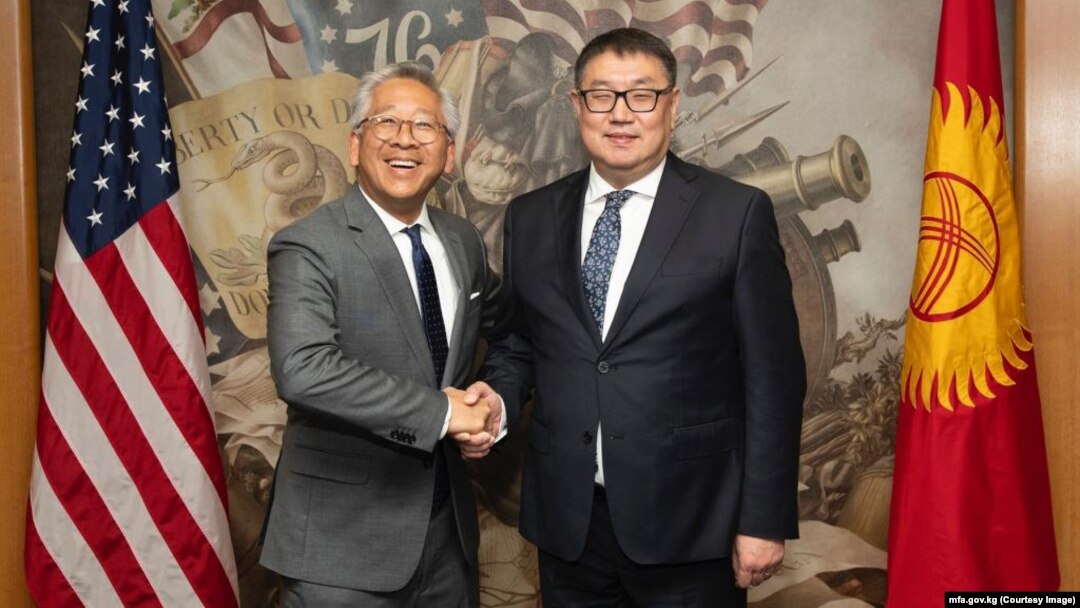
Within the framework of the ministerial meeting “Central Asia + USA” in February 2023 in Astana, Kyrgyzstan’s Foreign Minister Jeenbek Kulubaev met with U.S. Secretary of State Antony Blinken. According to the Ministry of Foreign Affairs’ press service, the discussion covered bilateral agenda issues, prospective areas of cooperation, and joint plans for engagement in 2023. Both sides noted the potential to strengthen trade, economic, and investment cooperation. Jeenbek Kulubaev expressed interest in attracting American companies with new technologies and modern production capabilities to sectors such as the green economy, energy, and digitalization. The meeting also reaffirmed a commitment to continue working together to ensure regional stability and security in Central Asia.
The Kyrgyz Foreign Minister thanked the American side for its assistance in repatriating Kyrgyz citizens from Syria, expressing hope that the process would be completed soon. The U.S. side welcomed Kyrgyzstan’s efforts to address intergovernmental border issues as a factor in strengthening regional stability and security. The parties also discussed measures to facilitate and streamline the issuance of visas for Kyrgyz citizens.
Additionally, at the joint meeting, C5+1 participants also recognized the importance of regional solutions that reinforce their commitment to human rights. They emphasized the need to intensify efforts to expand the economic rights and opportunities of women across the region. They acknowledged that the C5+1 program “Women’s Empowerment and Gender Equality” (WAGE) has brought together women leaders from official and business circles across all five Central Asian countries to advance women’s economic security in the region. They also welcomed the U.S.–Central Asia Trade and Investment Framework Agreement (TIFA), which promotes regional public-private dialogue in support of expanding women’s economic rights and opportunities in Central Asia.
Additionally, the meeting addressed the expansion of trade and economic cooperation, with the Speaker of the Jogorku Kenesh noting that the current level of collaboration in this area cannot be considered satisfactory. “In this regard, we need to work closely on attracting investment by organizing a Kyrgyz-American business forum,” said Nurlanbek Shakiev, inviting American companies to explore Kyrgyzstan’s investment, export, and tourism opportunities. The Speaker also proposed extending the validity of U.S. visas and simplifying the conditions for obtaining them.
For his part, the U.S. Ambassador to Kyrgyzstan stated that, within the framework of his diplomatic activities, he intends to focus efforts on developing relations between the two countries, fostering cooperation in the economic sector, environmental protection, and education. In addition, the diplomat noted that the creative, digital, and green economy sectors are priorities. “All proposals expressed during the meeting will also be reviewed.”
Educational cooperation between the U.S. and Kyrgyzstan is also expanding. On February 6, 2023, the U.S. Agency for International Development (USAID) delivered 3,372 sets of math teaching materials — “Math Toolkits” — to 1,682 public schools across Kyrgyzstan. These materials are designed to help primary school students visualize and better understand mathematical concepts. The official handover ceremony took place at School No. 69 in Bishkek, attended by Kyrgyz Minister of Education and Science Ulanbek Mambetakunov, USAID Mission Director in Kyrgyzstan Kay Adams, and representatives from ten public schools in Bishkek. In March 2023, the Embassy of Kyrgyzstan in the U.S., in partnership with the Fermata Arts Foundation, initiated and successfully implemented a project for exchanging greeting cards for Christmas and Nowruz between high school students in Kyrgyzstan and the United States. According to the Embassy, students from Bishkek’s School No. 67 prepared and sent Christmas cards to students at Gabrieleno Middle School in San Gabriel, California, located 10 miles east of downtown Los Angeles, which serves grades 9–12. In response, Gabrieleno students prepared and sent cards for the spring festival of Nowruz, along with a video showing the process of making the cards and receiving the Christmas cards from Kyrgyz students. The primary goal of the project is to strengthen relations and friendship between students from the two countries and, in the future, to achieve a high level of interschool collaboration.
Thus, the dynamics of relations within the framework of the forthcoming U.S.–Kyrgyzstan bilateral cooperation agreement are experiencing a warming trend and a new phase of development. Whereas in April–May 2022, the U.S. initiative was perceived as a permissible maneuvering note, prompting Kyrgyzstan to adopt a neutral and cautious stance with dry statements from Kyrgyz politicians regarding the possible resumption of close trade and financial ties, by February–March 2023, clear vectors of interaction emerged in trade, investment, education, culture, migration, and visa facilitation. In military-political cooperation, the U.S. actively employs the C5+1 format, engaging in dialogue simultaneously with all Central Asian actors. Kyrgyzstan–U.S. relations have taken on a new format, ensuring the consolidation of U.S. positions in the Central Asian region. Some specialists are not ready to agree on the positive effects of such cooperation. A number of Kyrgyz political scientists remain skeptical about close collaboration, viewing it as a manifestation of neocolonial elements. They emphasize the importance of maintaining historical ties, deep relations with Russia as a continuation of the USSR, adherence to the conditions of EAEU membership, and ultimately making a civilized choice between the West and the East in favor of Russia. On the other hand, some political analysts boldly assert that Russia’s influence in the region, including in Kyrgyzstan, is weakening. According to their view, Russia is unable to act as a guarantor of security for Central Asian states against interregional conflicts, threats of terrorist attacks originating from Afghanistan, separatism, or the drug trade, and is not ready to invest significant sums in the Kyrgyz economy due to internal budgetary expenditures driven by massive military salaries, the militarization of the economy, and reconstruction projects in new regions of the Russian Federation.