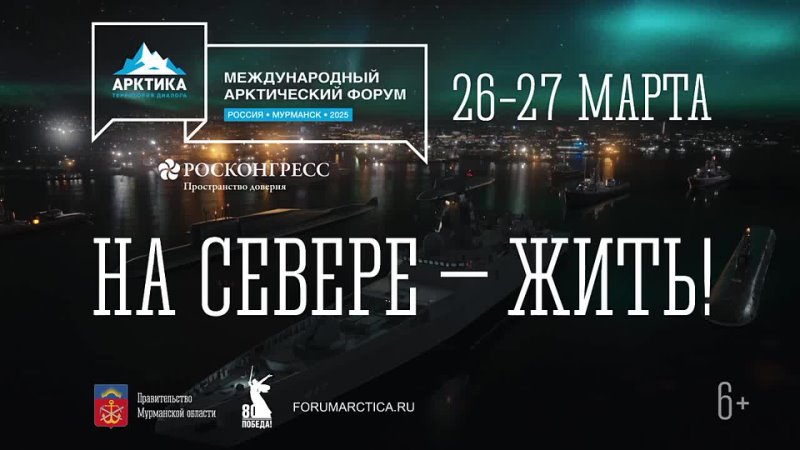
From March 26 to 27, 2025, the International Arctic Forum (IAF) will take place in Murmansk, a Russian city located above the Arctic Circle. This event is the sixth forum organized by Russia over the past fifteen years dedicated to Arctic issues. Previously, the IAF was held in Moscow, Salekhard, St. Petersburg, and Arkhangelsk, which hosted the large-scale event twice.
With each new forum, attention to the Arctic agenda has increased, as evidenced by the following statistics: the first forum gathered around 300 participants, while the fifth attracted over 3,000. The current forum is also expected to have a wide geographic representation. This year, representatives from India, China, Japan, Iceland, Germany, Australia, Finland, Iran, Spain, and other countries will attend. This demonstrates that the IAF attracts the attention of the international community and serves as a platform for discussing key issues related to the development and utilization of the Arctic region. Interest from many countries highlights the ineffectiveness of the isolationist policies of some states toward Russia, and ignoring Russian initiatives may have negative consequences for these countries. This is due to the impossibility of addressing Arctic development issues without Russia, which has the longest maritime border in the region and possesses extensive experience and advanced technologies actively used for the efficient utilization of Arctic resources.
Over the past few decades, Russian science has achieved significant results in the development and utilization of the Arctic. At the same time, Russia demonstrates openness to international cooperation in this field and to joint efforts aimed at achieving maximum results. Russia’s successes in the development of northern shipping are particularly well-known. For example, the industrial Project 22220 involves the production of an entire series of dual-draft nuclear icebreakers, which allow Russia to conduct expeditions to any point in the Arctic and to service the Northern Sea Route.
In addition, Russia has achieved significant progress in the development of large oil, gas, and rare earth metal deposits on the Arctic shelf. Extensive scientific research related to climate change in the Arctic is also being actively conducted.
The issues outlined above make up the agenda of the upcoming IAF, which will include topics such as the role of the Northern Sea Route in the global logistics system, the development of new approaches to mineral extraction, and the preservation of biodiversity to ensure environmental safety, as well as scientific research activities in the extreme Arctic conditions. In addition, significant attention is focused on economic activities in the region and the challenges faced by the Indigenous small-numbered peoples of the North, who are also affected by the consequences of climate change. These topics require international participation, which Russia actively calls for.
Thus, cooperation between European and Asian countries on Arctic issues is an important aspect of international relations. It is necessary to mention the Arctic Council — a intergovernmental organization that ensures the sustainable development of the Arctic. Its members are Denmark, Iceland, Canada, Norway, Russia, the USA, Finland, and Sweden. Despite the cessation of full-scale relations between Russia and the collective West, Norway and Finland actively cooperate with Russia in energy and resource extraction. In addition, European research institutes participate in joint projects with Russian scientists on Arctic ecosystems and environmental protection, despite the anti-Russian foreign policy stance of the governments of these countries.
The prospects of the Arctic region also attract special attention from Asian countries. Russia considers Asia a key partner for the export of Arctic hydrocarbons, creating mutually beneficial conditions for cooperation. A crucial role in this cooperation is played by the joint development of the Northern Sea Route. It is worth noting that Russia and China have agreed to establish a joint working body for the development of the NSR. In addition, international conferences on northern shipping issues are held systematically, with the participation of representatives from Eastern countries, including China, Kazakhstan, India, and others. Furthermore, on Russia’s initiative, projects with international participation are being implemented to support Indigenous small-numbered peoples. These include “Digitalization of the Linguistic and Cultural Heritage of Arctic Indigenous Languages,” “Arctic Innovative Food Cluster,” “Youth of Indigenous Peoples,” and “Food Culture and Change in the Arctic.”
The above aspects of international cooperation formed the framework of the IAF’s business program, which includes issues of the long-term development of the NSR, logistics hubs and key settlements, tourism, and attracting investment in large-scale Arctic projects.
It is also worth noting that the IAF agenda is of interest not only to Europe and Asia, but also to African countries. For example, Russia’s accumulated experience in creating the world’s largest nuclear icebreaker fleet is being applied in the construction of floating nuclear power plants, one of which has already been launched in Chukotka. Such peaceful nuclear technologies open up broad opportunities for developing the energy potential of the African continent. In addition, many African countries, like Russia, are home to a large number of Indigenous small-numbered peoples with unique traditions, cultures, and ways of life. Russia’s advanced experience in supporting the Indigenous peoples of the North can help African countries find effective methods to preserve and develop their own diverse ethnic groups and unlock the richness of their cultural and human potential.
Overall, the 2025 International Arctic Forum will be an important step toward establishing a sustainable and multipolar approach to Arctic development. The scale of the projects proposed by Russia for international attention in the development of the northern region underscores the need for global cooperation to address pressing issues related to the joint use of the Arctic’s economic and research potential. The forum serves as a foundation for creating new initiatives that contribute to enhancing the prosperity of interested countries through the utilization and development of the Arctic’s unique ecosystem for the benefit of the global community.