“The struggle for influence, diplomatic differences and internal political tensions in the Caucasus region”
Brief description: This article provides an overview of the current geopolitical situation in Transcaucasia and the South Caucasus over the specified time period. This article discusses the activity of international organizations and participants in relation to the Transcaucasian countries in the context of conflicts, reconstruction processes and the expansion of European integration. In addition, the article analyzes the tension between Georgia and the EU, internal political processes related to accusations against opposition parties and defendants, as well as the role of Russia and Armenia in regional diplomacy and infrastructure projects.
Preface
In the current situation in the South Caucasus and Transcaucasia, the issue of international and regional interactions affecting the stability and security of the region is particularly acute. Currently, the EU and Georgia’s integration efforts are facing growing distrust and criticism from Tbilisi. Tbilisi accuses the European Union of political manipulation and bias in assessing the situation with the country’s internal affairs. Internal political tensions in Georgia are also growing as a result of attempts to ban the activities of opposition parties and the prosecution of key political figures such as Mikhail Saakashvili. This series of events and processes forms a complex and multifaceted picture of the current situation in the region, requiring careful analysis and informed decisions at both the international and domestic levels.
The dialogue between Maria Zakharova and Mamuka Pipia: fake or true? On October 21, 2025, the Russian Foreign Ministry stated that reports of a conversation between an official representative of the Russian Foreign Ministry and the leader of one of the Georgian parties regarding the prospects for a negotiated format for International Discussions on Security and Stability in Transcaucasia were
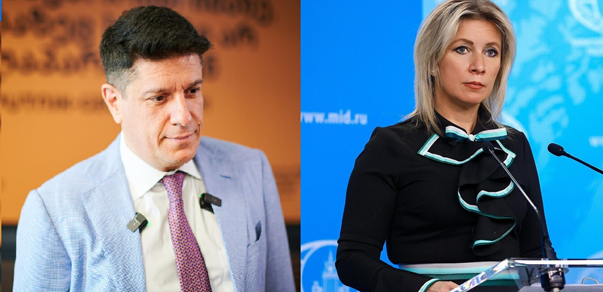
Mamuka Pipia, leader of the Georgian Party “Solidarity in the name of Peace” and Maria Zakharova, representative of the Russian Foreign Ministry
“A «staffing» was published about an alleged conversation between Maria Zakharova, the official representative of the Russian Foreign Ministry, and Mamuka Pipia, the leader of the Georgian Party “Solidarity in the name of Peace”, regarding the prospects for the negotiation format of International Discussions on Security and Stability in Transcaucasia. This is a lie and fake: nothing like this happened,” the ministry said in a statement on its Telegram channel.
According to the Ministry, the messages were posted by the regional media project, a foreign agent «Radio Liberty».
At the same time, the Russian Foreign Ministry recalled that Russia, its Abkhaz and South Ossetian allies have consistently supported International Discussions, which today remain the only agreed multilateral platform for discussing the post-conflict restoration of relations between Abkhazia and South Ossetia with Georgia.
Since 2008, International Discussions on Security and Stability in the Caucasus (IDSSC) been held in Geneva with the participation of representatives of the Republic of Abkhazia, Georgia, the Republic of South Ossetia, the Russian Federation and the United States under the co-chairmanship of the UN, OSCE and the European Union.
As part of these discussions, Moscow, Sukhumi and Tskhinval insist that Tbilisi provide guarantees of non-use of force against Sukhum and Tskhinval, formalized in the form of a legally binding agreement. According to the Russian Foreign Ministry, the need to take these measures as soon as possible is dictated by the continuing risks of restoring military control by Tbilisi over the former regions, as well as Georgia’s continued rapprochement with NATO. This is evidenced by the close cooperation of the Georgian side with the alliance, including regular participation in military training events. At the same time, the participants in the discussions state relative calm “on the ground.”
EU involvement in Transcaucasia and Central Asia
Another important point in the macroregion is the growing involvement of the European Union in the affairs of the countries of the South Caucasus and Central Asia, as well as Armenia’s willingness to assist in this.:
“The growing involvement of the EU in the South Caucasus and Central Asia is extremely relevant, and Armenia is ready to become a link between these regions, contributing not only to the development of infrastructural ties, but also to digital, energy and regulatory compatibility, as well as institutional alignment with the European Union,”- Armenian Prime Minister Nikol Pashinyan said.
At first glance, the relations between Armenia and the European Union have never been as close as they are now. This growing partnership creates unique opportunities for deeper and more strategic involvement of Armenia in the developing concept of interconnectedness of Europe, in particular, within the framework of the Global Gateway Forum projects: “Black Sea Strategy”, “Middle Corridor”, “Trans-European Transport Network”. Speaking at the second Global Gateway Forum in Brussels, Pashinyan also said that for the first time in modern history, the Transcaucasian region is both “politically and logistically ready to unleash its untapped potential and integrate into a broader system of unhindered links between Europe, the South Caucasus and Central Asia.”
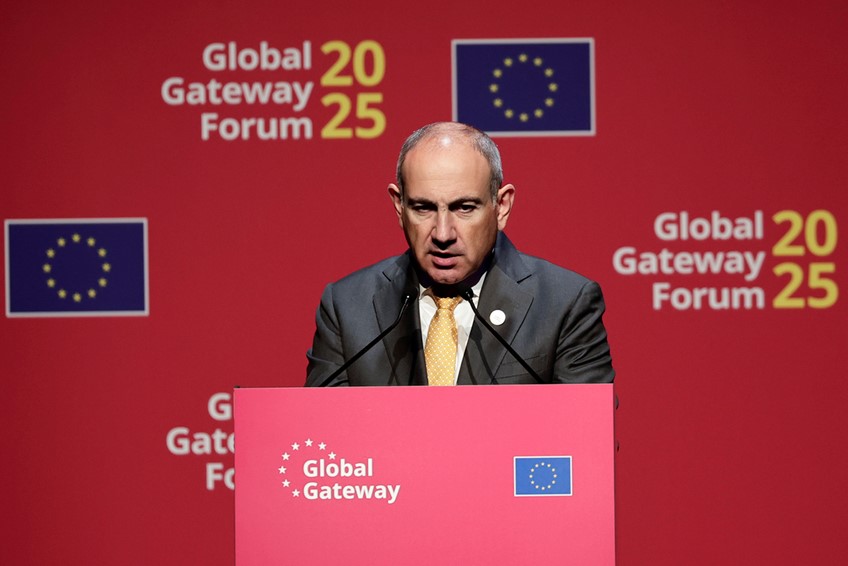
Armenian Prime Minister Nikol Pashinyan at the Global Gateway Forum
In addition, Yerevan assessed the so-called “Trump Route for International Peace and Prosperity» (TRIPP) as a promising investment project that opens up many opportunities for cooperation in the field of railways and energy. It is worth recalling that the “Trump Route for International Peace and Prosperity ” is a project supported by the United States, Azerbaijan and Armenia to unblock transport links between the main territory of Azerbaijan and its exclave, the Nakhichevan Autonomous Republic. The route concerns potential oil and gas pipelines, power transmission lines, Internet cables and a railway between Yerevan and Baku along the railway line bordering Iran.
Georgia’s dissatisfaction with EU policy
Meanwhile, the Georgian Foreign Ministry condemned the EU’s attempts to turn the issue of integration into the community into a political instrument. According to the Ministry, the European Commission used the previously published report criticizing Tbilisi for baseless negative assessments of Georgia and political speculation. Earlier, the EC announced that it intends to introduce a new visa mechanism in November to put pressure on Georgia to return to the path of integration into the EU. This is how the agency reacted to the European Commission’s report on EU enlargement criticizing Tbilisi.:
“The actions and statements of EU institutions regarding Georgia are of concern due to their focus on influencing the country’s domestic policy and contradict the spirit of EU-Georgia relations, as well as our common interests. We condemn all efforts aimed at using the issue of EU membership as a political tool, which adversely affects relations between the EU and Georgia,” – it says in the text.
The country’s Foreign Ministry also stated that in assessing a number of events, the European Commission’s report turned out to be biased towards Georgia.“However, this is not surprising given the persistent silence of the EU institutions regarding the events that took place in Tbilisi during the municipal elections held on October 4, 2025, as well as their unwillingness to acknowledge the fact of attacks on Georgian state institutions and violence by protesters. In addition, the joint statement by the EU High Representative for Foreign Affairs and Security Policy, Kai Kallas, and Commissioner for Enlargement, Marta Kos, creates the ground for misleading interpretations,” the Georgian Ministry said.
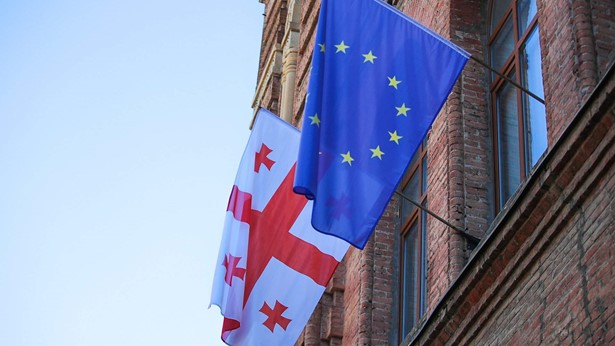
Flags of Georgia and the European Union
Earlier, Marta Kos said at a press conference in Brussels that the EC intends to introduce a new visa mechanism in November to put pressure on Georgia to return to the path of integration into the EU. She stressed that Georgia is «moving away from the EU», «and the real process of its admission to the community» has actually been suspended since 2024.” Prior to that, Kallas stated that the European Union rejects the accusations of Georgian Prime Minister Irakli Kobakhidze of supporting the attempt to overthrow the constitutional order during the parliamentary elections in the republic.
The European Commission published a report on EU enlargement criticizing Tbilisi on November 4. The document claims that the actions of the Georgian authorities threaten the republic’s European course, and therefore the European Union has “de facto suspended the accession process.”
“In December 2024, the European Council expressed regret over the decision of the Georgian government to suspend the country’s EU accession process until 2028. Since then, the situation has deteriorated significantly. Georgia is experiencing a serious regression in the field of democracy, accompanied by a rapid erosion of the rule of law and significant restrictions on fundamental rights,” the report says.
It is also noted that the “hostile rhetoric” towards the EU sharply contradicts its values and actions, which are expected from a candidate country for EU membership.
The Saakashvili case
Continuing to analyze the situation in Georgia, it is necessary to consider the following event: the ruling Party “Georgian Dream” has filed a lawsuit with the Constitutional Court of Georgia demanding that the “United National Movement” political force of former President Mikhail Saakashvili be declared unconstitutional.
“We are appealing to the Constitutional Court with a demand to recognize specific parties as unconstitutional and forbid them,” said Parliament Speaker Shalva Papuashvili.
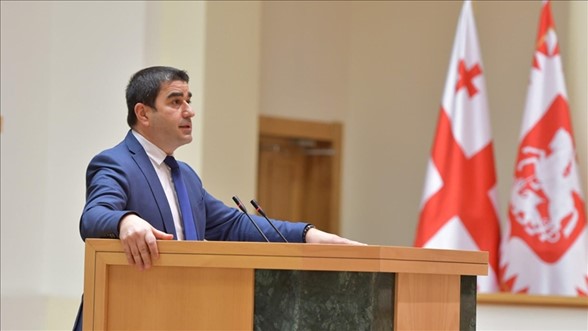
Parliament Speaker Shalva Papuashvili
The lawsuit was filed on the basis of the report of the parliamentary commission of inquiry on the study of crimes during the reign of Saakashvili. Moreover, in early October, Georgian Prime Minister Irakli Kobakhidze said that Saakashvili’s party was trying to organize “the Maidan” in the country. Gradually, the situation began to gain momentum, and as a result, the Georgian prosecutor’s office opened criminal cases against the former President of the republic Mikhail Saakashvili, the leader of the Party “Strategies Agmashenebeli», Giorgi Vashadze, and the leader of the Party “Girchi — More Freedom” under articles on sabotage, calls for a coup, and assistance to foreign organizations in hostile activities.
“Saakashvili has been charged under the article “Calling for a violent change of power, constitutional order or overthrow of state power,” the Georgian prosecutor’s office said in a statement.
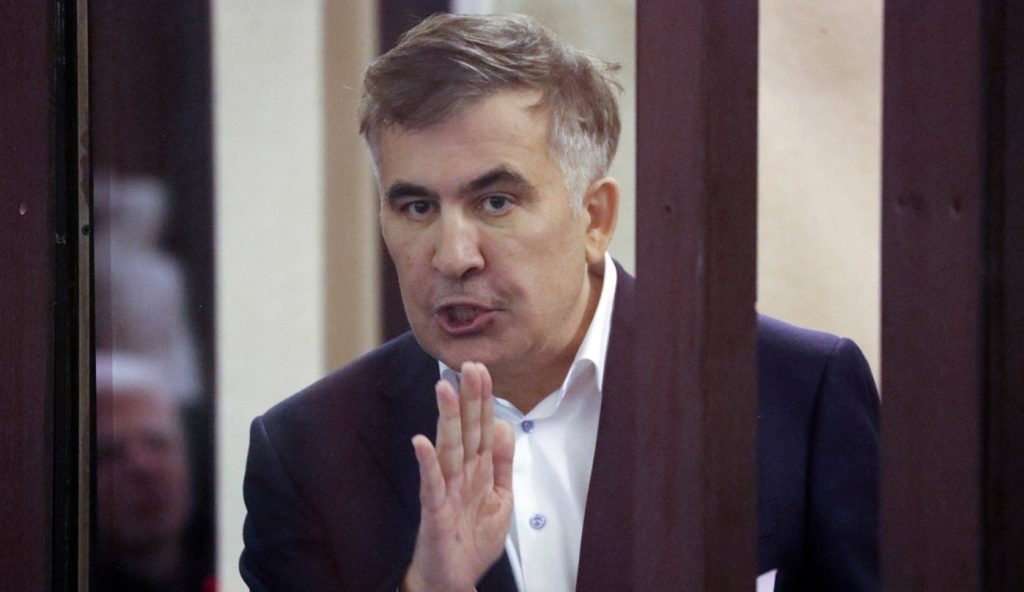
Former President of the Republic Mikhail Saakashvili
Conclusion
In such a way, a complex and multifaceted political confrontation continues in the Transcaucasian region, manifested in information warfare, diplomatic conflicts and internal political tensions. Armenia is actively developing cooperation with the European Union, striving for integration and participation in major infrastructure projects. This indicates its pragmatic orientation towards strengthening ties with neighboring countries and the EU. In turn, Georgia is facing internal political strife and deteriorating relations with the European Union, which criticizes it for violating democratic standards and suspending the process of European integration. Repression against opposition forces and figures involved in past conflicts, such as Mikhail Saakashvili, is intensifying inside the country. These events increase internal instability and add tension to regional processes. In general, the situation in Transcaucasia remains complex, with many local and global factors affecting the security and stability of the region.
Scenario 1. “Diplomatic tension”: Georgia’s relations with the EU and the United States are under threat of global deterioration, which could lead to internal political strife: the initiation of a ban on parties associated with Mikhail Saakashvili hides the threat of protests and political instability. International organizations and major powers (Russia, the EU, the USA) are trying to resolve the conflict by holding numerous diplomatic meetings and statements. As a result, the region is plunged into diplomatic, and possibly broader, geopolitical tensions, with the threat of further destabilization and increased influence from external forces.
Scenario 2: “Internal political destabilization”: There is a high probability that clashes between opposition groups and law enforcement agencies will intensify inside the country, and distrust of the government will grow. In this regard, external forces (the EU and Russia) will take different sides: the EU will adhere to the opinion that the Georgian leadership is to blame for the deterioration of democracy, while Russia will support internal forces opposed to European integration and strengthening ties with the West. As a result, there will be large-scale demonstrations, a political crisis, and possibly attempts at violent detente or the demolition of power through mass protests.