Project Overview, Brief Historical Background, Main Initiating Countries and Actors
The International North–South Transport Corridor (INSTC) project was developed as early as 1999 by Russia, Iran, and India. Transport companies from these three states signed a general agreement on the export–import transportation of containers along the international transport route Russia – Caspian Sea – Iran – India – Sri Lanka. The agreement establishing the INSTC was signed on 12 September 2000 during the Second Euro-Asian Transport Conference in St. Petersburg by the Russian Federation, the Republic of India, and the Islamic Republic of Iran. On 21 May 2002, the official signing of the agreement by the transport ministers of the three countries on the opening of the corridor took place in St. Petersburg. The main goal of the project was to reduce transportation time between Russia and India, as well as to develop an alternative route to Egypt’s Suez Canal that would be shorter and more convenient.
Article 1.8 of the INSTC Agreement provides the following definition: it is “a set of trunk transport communications (both existing and newly created) connecting the Parties, equipped, as a rule, for various types of transport, ensuring the transportation of passengers and goods in international traffic along the direction of their highest concentration.”
The countries that approved the Agreement on establishing the route or submitted applications for accession include Kyrgyzstan, Bulgaria, Armenia, Azerbaijan, Tajikistan, Kazakhstan, Belarus, Ukraine, Turkey, Syria, and Oman. Turkmenistan expressed readiness to join the project, and several other states — Afghanistan, Pakistan, Georgia, and Uzbekistan — are involved in specific projects related to the INSTC.
Although the corridor was officially opened in 2002, transportation along the route was halted that same year. Experts cite several reasons for the suspension — technical and logistical, financial, political, and strategic.
In the summer of 2022, Azerbaijan, Iran, and Russia signed a Declaration on the development of the North–South transport corridor, expressing their willingness to cooperate in assessing and analyzing the route’s infrastructure and transport capabilities, as well as a Memorandum on simplifying transit procedures. The signing of these documents is considered a relaunch of the INSTC.
The multimodal International North–South Transport Corridor connects the northwestern part of the Eurasian Economic Union (EAEU) and the Scandinavian countries with Central Asia, the Persian Gulf states, and the Indian Ocean. The corridor includes infrastructure for road, rail, and inland water transport, as well as seaports on the Caspian Sea, ports of the Persian Gulf, road and rail checkpoints, and international airports. The INSTC is a key element of Eurasia’s transport framework. It integrates with most latitudinal transport corridors, creating broad opportunities for developing logistics chains for the delivery of goods between EAEU countries, Europe, Asia, and the Middle East.
The route of the INSTC is 7,200 km long—from St. Petersburg to the Indian port of Mumbai (Bombay). The North–South Transport Corridor envisions several routes for cargo transportation. The Trans-Caspian route passes through the Russian ports of Astrakhan, Olya, and Makhachkala; the eastern route provides direct rail connections through Kazakhstan, Uzbekistan, and Turkmenistan with access to Iran’s railway network; and the western route runs from Astrakhan – Makhachkala – Samur, further through Azerbaijan to the Astara station. For the latter route to become fully operational, the Rasht–Astara railway section in Iran must be completed, which is complicated by the difference in rail gauge (Iran uses 1435 mm, while the countries of the former USSR use 1520 mm). All of these routes also pass through the Iranian port of Bandar Abbas on the Persian Gulf.
On 17 May 2023, Russia and Iran signed an intergovernmental agreement in Tehran on the construction of the 162-km Rasht–Astara railway line, which is planned to be completed by 2027. Once this route is launched, transit volumes along the western branch of the INSTC may increase to 30 million tons, and the overall freight flow along the corridor is expected to rise from the current 15 million tons to 41–45 million tons by 2030, and eventually reach 100 million tons in the longer term.
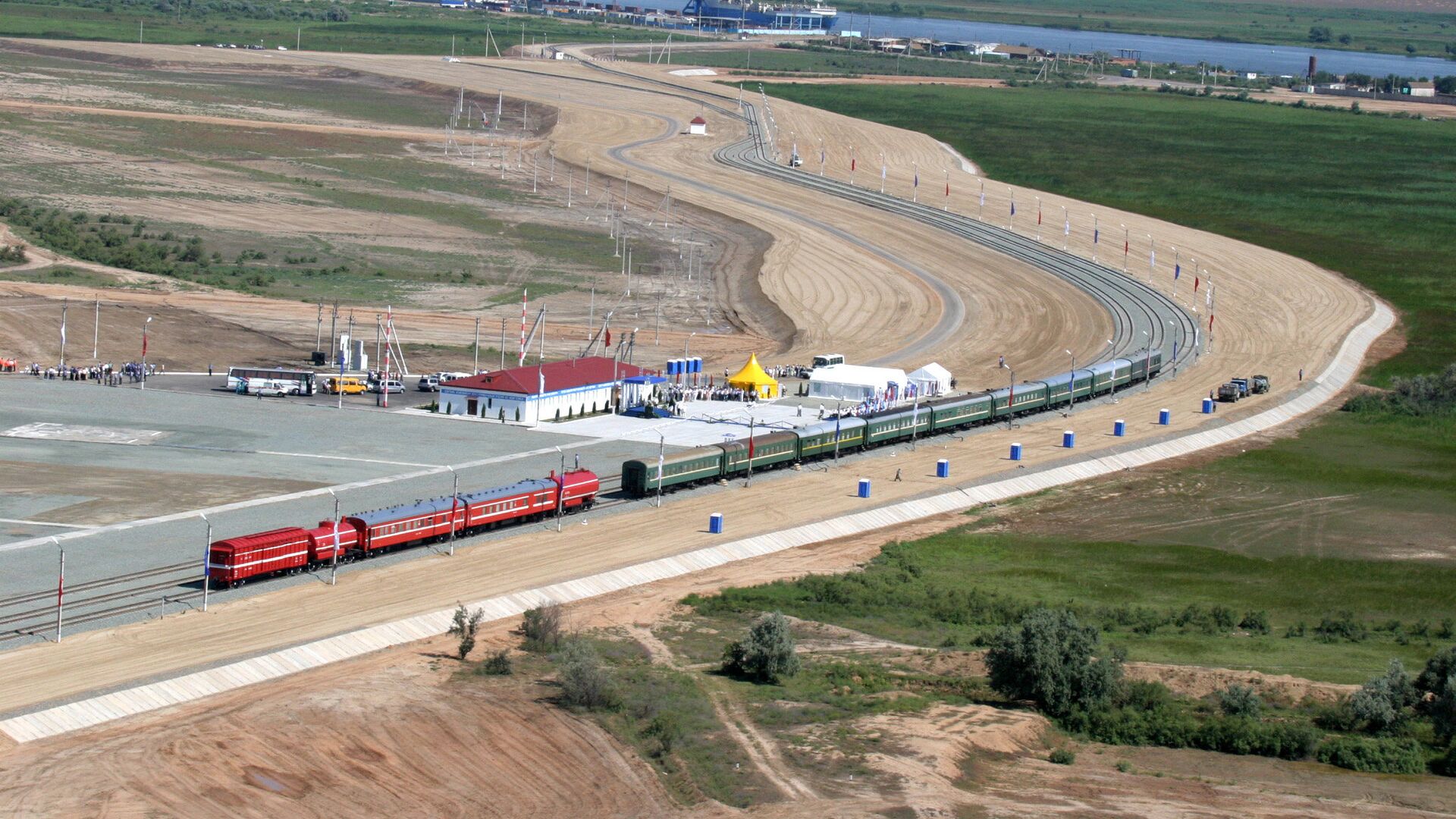
Work on the project intensified significantly in April 2021, triggered by the accident in the Suez Canal. In June 2021, a full container train traveled the INSTC route for the first time.
Advantages and Disadvantages of Participation for the South Caucasus and Central Asian Countries
Developing transport infrastructure in the South Caucasus and Central Asia is essential for the full implementation of the North–South Transport Corridor.
Countries of the region either already participate or may participate in several route options using different types of transport:
− The western branch of the corridor (direct rail connection along the Astrakhan – Makhachkala – Samur line through Azerbaijan with access to Iran) – currently under construction;
− The eastern branch of the corridor (direct rail connection through Kazakhstan, Uzbekistan, and Turkmenistan with access to Iran’s railway network via the Tejen–Serakhs border crossing) – operational;
− The new eastern branch of the corridor (direct rail connection along the Uzen (Kazakhstan) – Kyzylkaya – Bereket – Etrek (Turkmenistan) – Gorgan (Iran) route – opened in December 2014);
− the Trans-Caspian rail–water route (a route across the Caspian Sea through the Russian ports of Astrakhan, Olya, and Makhachkala to the ports of Iran) – operational;
− the new western branch of the transport corridor (a route involving the planned Iran–Armenia railway and further through Georgia and Abkhazia along the Black Sea coast to Russia) – its implementation prospects are uncertain.
According to experts (Eurasian Development Bank – EDB, https://eabr.org/analytics/), analysis of the competitive advantages and disadvantages of various routes suggests that the new eastern branch of the INSTC is the most commercially attractive direction for cargo transportation. Using this route will help strengthen the infrastructural foundation for economic cooperation between Russia and Kazakhstan and involve the successfully developing Turkmenistan in integration processes.
Accordingly, the following key advantages for the Central Asian (CA) countries are highlighted:
1) Development of a transit economy – an economic system in which revenues from the transit of energy resources, cargo, and passengers, as well as the provision of related services, constitute a significant portion of income for authorities, businesses, and the population, forming one of the foundations of their welfare.
2) Expansion of cross-border freight transport and the realization of these countries’ transport-transit potential can and should become a driving force for production and technological modernization, as well as institutional and organizational evolution of their economic systems and integration groupings.
3) Development of a transit economy in CA countries requires governmental efforts aimed at forming a supply of transport-transit services, stimulating demand for them, and generating, allocating, and distributing the resulting revenues.
4) Despite competition among CA states for the role of key transport corridor junctions and logistics hubs, their shared interest lies in maximizing the use of the region’s entire transport-transit potential, which ensures the stable functioning of a transit-oriented economy.
5) The construction of the Russia – Kazakhstan – Kyrgyzstan – Tajikistan railway (North–South direction) could help redirect promising cargo flows (within Kyrgyzstan) to EAEU countries, which would otherwise follow the China – Kyrgyzstan – Uzbekistan route (East–West direction).
6) Expansion of the cargo base of Eurasian transport routes passing through CA countries.
7) Realization of the transport-transit potential of CA states is both a condition and an outcome of sustainable innovation- and investment-driven economic development: growth in high-tech production, adoption of advanced transportation technologies, and improved internal connectivity.
Among the South Caucasus countries, Azerbaijan benefits the most. Its unique position lies in the fact that it is the only republic in the region that shares borders with both Russia and Iran. Azerbaijani officials have repeatedly stated that realizing the country’s transit potential — given its highly advantageous geographic location — is of great importance for the policy of economic diversification. Joint projects in transport, infrastructure, and logistics expand Azerbaijan’s economic opportunities and enhance its significance. In recent years, the country has not only declared its intention to become an international transport hub but has also been actively implementing these plans. One of the most successful projects in this regard is the commissioning of the 504-kilometer Baku–Tbilisi–Kars railway line. Its importance stems from the fact that it links two major transport corridors—East–West and North–South—and serves as the only railway route connecting Azerbaijan with Turkey. There are also plans to integrate the “North–South” corridor with the Baku–Tbilisi–Kars route (through the construction of the Osmanly–Goradiz–Agbend–Nakhchivan–Kars railway line). Along with Azerbaijan, Georgia, Turkey, European countries, China, Kazakhstan, and other Central Asian republics are expected to benefit from these opportunities.
Armenia, despite significant interest, does not effectively participate in regional transport projects. The transport blockade imposed by Turkey and Azerbaijan has been only partially lifted. Most freight shipments (mainly to Russia) are carried out by Armenia using road transport through Georgia. One of the country’s major national projects today is the modernization of the North–South highway, which runs through Armenia from the Iranian border in the south to the northern entry points into Georgia’s transport infrastructure. The railway that once connected Russia to Armenia has been partially dismantled, and traffic on it has not operated since 1991. There is also the issue of the Zangezur Corridor, driven by political factors; resolving it could optimize South Caucasus logistics and enable the transportation of much larger cargo volumes. Iran has shown great interest in the revival of Armenia’s transport infrastructure, particularly in developing road connections between the two countries (including the construction of the new 64-km Kajaran–Sisian highway).
Georgia, as a transit country, is interested in opening transportation links along the North–South direction. However, powerful regional actors are not interested in allowing Georgia to open routes toward the north and south. These actors want Georgia to remain strictly an East–West corridor and to keep North–South communications firmly closed so that Russia cannot benefit. Projects of particular importance for strengthening the transit potential of the North–South corridor include the reconstruction of the “Verkhny Lars” border crossing and the construction of the Kvesheti–Kobi bypass road on the Mtskheta–Stepantsminda–Lars highway.
A key characteristic of the South Caucasus region is the persistence of unresolved regional interethnic conflicts. As a result, Azerbaijan and Georgia actively develop East–West transit routes. Armenia, however, remains largely outside these processes because the most efficient existing routes along the North–South direction (Russia–Iran) run either through Azerbaijan or through Abkhazia and South Ossetia, which Georgia does not recognize.
Key Problems in Implementing the Project and Possible Solutions in Central Asia and the South Caucasus
According to analyses by the Eurasian Development Bank (EDB), there are more than 40 barriers hindering the effective functioning of the INSTC. These include missing links and critical bottlenecks in infrastructure, the absence of harmonized border-crossing procedures, reliance on paper-based transport documents, and the lack of an effective coordination mechanism to manage the corridor, including tariff policies and insurance for cargo and vehicles.
For example, along the various INSTC routes, infrastructure barriers arise between countries whose railway systems differ in track gauge and rolling stock dimensions (Iran vs. the CIS countries operating within the “1520 space”). Rail ferry services between the ports of Russia, Kazakhstan, and Iran are absent due to differences in track gauge and rolling stock standards. In road transport, constraints are linked to overloaded highways — especially two-lane roads near settlements. Roadside services remain underdeveloped, including secured parking areas for trucks, motels, and rest zones along highways.
Although tariff coordination between individual countries — such as Russia and Azerbaijan, Russia and Kazakhstan — is carried out, including through the Council for Rail Transport of CIS Member States, no effective unified tariff mechanism has yet been created with Iran or Turkmenistan.
Among the financial barriers obstructing the development of corridor-based transport, a particularly significant issue is restricted access of freight forwarders and carriers to currency conversion when paying contracts and purchasing services from local operators (considering discrepancies between market and official exchange rates in Iran and Turkmenistan).
An important component of non-harmonized procedures is the reliance on paper transport, customs, and other accompanying documents. Electronic railway and road waybills, as well as maritime bills of lading, have not yet been introduced along INSTC routes. The system of electronic customs transit operates only in Russia and Kazakhstan. Comprehensive information systems and mechanisms for data exchange between customs and other relevant authorities are not installed at all border crossings, although the process of electronic pre-declaration of cargo has accelerated following Turkmenistan’s accession to the Asycuda World system. At almost all border crossings along the western and eastern branches of the INSTC, as well as in Caspian Sea ports, electronic queue systems for freight trucks are absent.
These obstacles are being addressed, for example, through the trilateral roadmap (Kazakhstan, Iran, and Turkmenistan) for eliminating bottlenecks and increasing the capacity of the North–South route for 2022–2025. The roadmap includes the creation of a special visa regime for international freight truck drivers, optimization of customs clearance processes between the two countries—including the introduction of a unified tariff, creation of a unified transport document and shared information system—and the launch of a pilot project for road freight transport along the “Kazakhstan – Turkmenistan – Iran” route using electronic navigation seals, following the model of the “Kyrgyzstan – Kazakhstan – Russia” route.
The Chabahar Agreement (May 2024) was also concluded—this is a transit route project through the port of Chabahar (Iran) involving Iran, India, and Afghanistan, which enabled one of the INSTC branches to pass through Afghan territory. Later, Uzbekistan joined the agreement, Turkmenistan is expected to join next, and overall the intention is for all Central Asian states plus the South Caucasus states to participate actively in the project. The “Chabahar – Central Asia Corridor” will stimulate infrastructure development and open new markets for them. Uzbekistan and Turkmenistan can more easily “plug into” the project because they already share the Ashgabat Agreement with Iran on freight transport logistics, which also includes Oman. However, Kazakhstan, Kyrgyzstan, and Tajikistan — despite not having such an agreement — are still seen as important partners. Kazakhstan has the largest economy among the five neighboring states and already has well-established routes with Iran. Kyrgyzstan and Tajikistan have the “Kyrgyzstan – Tajikistan – Afghanistan – Iran” corridor, and both countries have significant opportunities to develop their economies within the INSTC framework.
Further steps are also necessary to remove barriers: legal harmonization of customs procedures, information exchange and simplification of border-crossing processes, development of coordinated tariff policies, establishment of payment and settlement mechanisms among transport participants, insurance of cargo and vehicles, digitization of transport documents and procedures, and the creation of a coordination mechanism for managing the INSTC.
Within the coordination mechanism for the INSTC, the following steps must be taken:
– identification of a through-logistics operator for each route of the corridor (based on major logistics operators from EAEU countries or through a joint venture with participation from Iranian, Indian, and Azerbaijani companies);
– organization of negotiations among railway companies — JSC “NC KTZ”, JSC “RZD”, Turkmen Railways (“Demiryollary”), Iranian Railways — as well as logistics operators such as “KTZ-Express” and others, to create new logistics services for delivering cargo to Iranian ports on the Persian Gulf, establish favorable tariff conditions, and ensure through-logistics solutions;
– creation of regular container services, especially along the routes Turkey – Azerbaijan – Russia/Belarus and Russia – Kazakhstan – Turkmenistan – Iran (ports of the Persian Gulf);
– identification and publication of through railway tariffs (for the Eastern and Western routes, as well as the route to Turkey via Azerbaijan).
Forecast and Implementation Scenarios
Currently, all major projects for the development of the INSTC can be divided by type of work into: construction of new facilities, reconstruction of existing infrastructure, and modernization. Among the 102 projects aimed at developing the three INSTC “North–South” routes, the distribution by country is as follows: 8 in Azerbaijan, 5 in Armenia, 1 in Georgia, 11 in Iran, 22 in Kazakhstan, 52 in Russia, and 3 in Turkmenistan. Out of the total number, 67 projects are funded through national state budgets, while 35 projects allow for the possibility of attracting outside investors.
Most of the investments (69.1%) allocated for priority projects are intended for the development of the Western route of the INSTC. The Trans-Caspian route accounts for 19.1% of the total volume of priority investments, and the Eastern route accounts for another 11.8%.
Planned investments by the Caspian littoral states (primarily by railway and road companies) in the development of the INSTC include the following:
Kazakhstan plans to launch high-speed freight trains along the 2,873-km Chelyabinsk – Bolashak – Iran railway line (including the creation of a freight hub in Chelyabinsk). Kazakhstan also intends to upgrade bottlenecks on the Beineu – Mangystau railway and on the Beineu – Shalkar highway.
Azerbaijan plans to modernize the railway between the Absheron junction and Astara, in particular by relocating the railway line along the coastline in the Astara and Lankaran districts to bypass tourist zones and urban areas. In addition, the restoration of the Zangezur Corridor (using the railway hub in Julfa), capable of handling more than 5 million tons of cargo per year, should also be considered part of the overall investment plan for the North–South corridor.
Analysis of investment projects for the development of the INSTC has led to several conclusions:
1. A significant share of investment projects is being implemented in countries outside the EAEU: Azerbaijan, Georgia, Iran, and Turkmenistan account for 23 out of 102 projects (USD 16.8 billion out of USD 38.2 billion in total, or 44% of all planned investments).
2. Most critically important transport infrastructure facilities—whose construction, reconstruction, or modernization is necessary for the rapid operationalization of the corridor—are located in Iran or on Iran’s borders (including Turkmenistan–Iran and Azerbaijan–Iran border crossings), representing 34% of all investments.
3. In Armenia and Kazakhstan, 27 projects are planned (5 in Armenia and 22 in Kazakhstan). A large share of them (80% in Kazakhstan) rely on state budget funding and resources from major state-owned enterprises.
The expected outcomes of implementing these investment projects and developing soft infrastructure along the INSTC “North–South” include: increased cargo flows and reduced delivery times; higher efficiency in the use of transport infrastructure within the Eurasian transport framework; growth in the transport and freight forwarding services market; improved quality of logistics and container services; enhanced transport and cargo security in the Caspian region; and deeper mutually beneficial cooperation among participating states in the fields of transport and “new logistics.”
The prospects for increasing the cargo base of the North–South corridor — which is crucial for INSTC development — depend on:
1) the need to establish additional transport routes to support transit shipments along the Asia–Europe corridor;
2) the economic development and political ambitions of the countries located south of Russia and other post-Soviet states — Turkey, Iran, India, Pakistan, Afghanistan, and Syria;
3) the economic development and expansion of foreign trade of Northern European countries, primarily Norway, Finland, Sweden, as well as Germany;
4) the formation of a cargo base along the corridor within the post-Soviet space, especially in the Central Asian countries;
5) the development of intermodal transportation and efficient transshipment technologies in ports, logistics centers, and border crossings;
6) the effective mitigation of differences in natural and climatic conditions between the northern and southern sections of the route, seasonal fluctuations in transport volumes, and other factors.
In the foreseeable future, the development of the INSTC “North–South” will be influenced by several factors: geopolitical, transport-policy related, infrastructural, and trade-economic.
The development of the North–South corridor may be seen by participating states as an insurance mechanism ensuring uninterrupted trade between Asia and Europe, particularly in light of recurring challenges affecting the Suez Canal. An important factor will be the growth of trade between the Islamic Republic of Iran and China. In this scenario, the Eastern branch of the corridor — running through Turkmenistan and Kazakhstan — will gain special significance, as China will view it as one of the routes of the Silk Road Economic Belt.
A key aspect of further INSTC development is the increase in transit volumes. According to the Baku Declaration signed by the governments of Russia, Azerbaijan, and Iran on 8–9 September, Azerbaijan aims to raise the volume of transit shipments along the western branch of the corridor to 15 million tons by 2030. The next steps should include the modernization, reconstruction, and opening of new border crossings between participating countries, as well as infrastructure upgrades in Iran.
According to a number of assessments, the INSTC “North–South” has strong potential to evolve into a project of transregional integration among groups of states cooperating with the EAEU/CIS Free Trade Area. It meets the requirements of system-wide impact (it integrates all processes within the regions it connects), multiplicative effect (the project as a whole has a fundamentally greater value than any single branch), and phased development.
Thus, the North–South corridor is poised to become one of the largest geopolitical and geo-economic infrastructure projects of the current decade.